
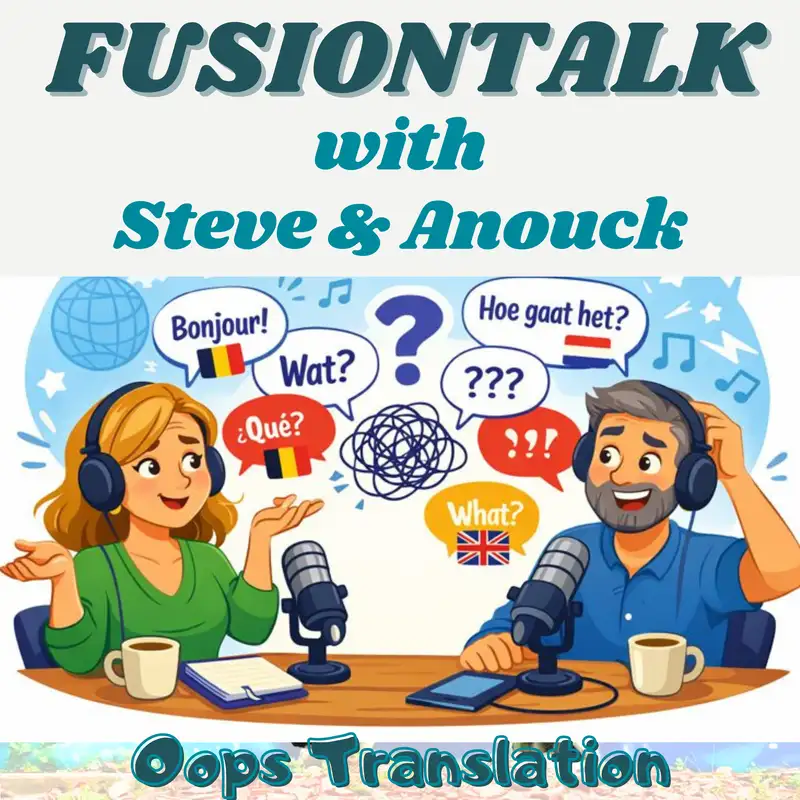
 Episode 37
· 46:06
>> Steve: Welcome m to fusion.
>> Anouk: Talk with anouk and steve. Happy New Year. What did you say? I said, happy New Year.
>> Steve: It's the same thing, different language.
>> Anouk: So I understood me, but, uh, you don't understand you.
>> Steve: I understand me.
>> Anouk: I don't understand you.
>> Steve: Yeah, but that's your issue.
>> Anouk: Oh, it's my issue.
>> Steve: It's the language issue.
>> Anouk: Is it not about understanding your audience?
>> Steve: Yes, maybe.
>> Anouk: First point. First point in Steve Dolby wins.
>> Steve: But that's the entire thing.
>> Anouk: I get it.
>> Steve: It's an understanding issue, so.
>> Anouk: But let's just talk about that responsibility change for a second, because that's quite valid. If somebody sends an email to me in Dutch, do I shout at them and tell them to translate it, or do I use translation tools to translate it for me? It's my responsibility.
>> Steve: In your case, you probably will ask them to translate it for you, but other, uh, people.
>> Anouk: No, I won't. That's unf.
>> Steve: No, you. Most of us will try to use translation tools to do translated themselves.
>> Anouk: Yep.
>> Steve: But some people don't know how those tools work.
>> Anouk: No. In my case, I don't often know what original language the email was sent in because it just sends it translates it to England. English.
>> Steve: Yeah.
>> Anouk: Same with web pages. But anyway. All right, so we've got a statement that we wanted to kind of kick off with, but then we got distracted.
>> Steve: Yes. So we want to kick off with the fact that we don't have communication issues, but we do have understanding issues.
>> Anouk: Yeah, exactly. That we just talked about. You spoke. You communicated happiness, joy. Yeah, but I didn't understand it.
>> Steve: True.
>> Anouk: I mean, obviously I did. But just for the sake of this podcast, let's assume that my Dutch really is that bad. It is gonna be one of those days today.
>> Steve: Sorry. So, but before we dive into this, how was your New Year's Eve and Christmas period?
>> Anouk: Oh, it's good.
>> Steve: Did you enjoy it?
>> Anouk: Yeah, yeah. Stayed over here in Antwerp. My family, or some of my family came over from England, so my stepson came over and his family, which was great fun. First people in the house that stayed over or first family. Um, I said my brother. That's not really true. Um, so first of my direct family. Uh, yes, they enjoyed Antwerp. We went, uh, to see some pretty cool things. Went to a great museum, um, which I can't remember the name of. Um, somebody. Or the purse. Yeah, whatever. But it was a. Basically about a guy in the 1500s that ran a printing company.
>> Steve: Okay.
>> Anouk: And so the museums was about that company. It was really neat because the word entrepreneur. I Know it from the last 25, 30 years. But this guy was an entrepreneur.
>> Steve: You saw it already in that, in that stage then. Yeah, they didn't have a word for it.
>> Anouk: No, they didn't. They didn't have word. One of the most amazing things, they sold some books in Africa for two diamonds and a ruby. So it shows how difficult books were. Or rare. Rare. They were. So yeah, we did that. We. We uh, saw the fireworks over the river and. Which uh, was spectacular. Yeah, uh, it was good. Very, very enjoyable. Very enjoyable.
>> Steve: And you uh, stayed home, had some friends and family over with Christmas and during the period. Too many parties to attend as always. But yeah, it was great. It was fun. A new year, uh, we had friends over so um, making dinner together, sitting at the table, having fun, being outside, watching the fireworks as well. Even it was not allowed in my place.
>> Anouk: No, um, there were a bunch of kids had got all fireworks, setting them up in the streets. That wasn't really very pleasant.
>> Steve: So yeah, we had some nice time as well.
>> Anouk: Good, good. So here we are, 2026.
>> Steve: Yes.
>> Anouk: Any new Year's resolutions?
>> Steve: Not really, no.
>> Anouk: No. I'm going to learn to speak Dutch again. That's the same as I've. Same as I have done for the last seven, eight I think you tell.
>> Steve: Me that for the third year in a row now.
>> Anouk: So that's true.
>> Steve: I don't believe it though until I see it happening.
>> Anouk: And I'm going to learn how to do the Argentinian tango.
>> Steve: That will be. That will be fun.
>> Anouk: Yes. So that's true especially you're going to be actually doing it as well. You know that, don't you? I need a partner. What are you doing next week? Learning Argentinian tanko.
>> Steve: Yes.
>> Anouk: Good, good, good, good. I'll hold you to that. I've got witnesses. Yeah, we wanted to do that for many years as well enough and um, suddenly sent me a leaflet or something. So I'm m gonna do something silly like that. But. But nothing. Nothing overly serious. No, quite honestly, um, yeah, I wasn't thinking about dancing, but I was just thinking no New Year's resolutions that I'm overly serious about.
>> Steve: I didn't make any New Year's resolutions.
>> Anouk: Now what was I watching or talking to somebody? Ah, no, it's a book I was reading and um, it was a family tradition that they all set a goal and it was a fairly well off family in the book and so they were doing things like, you know, going um, to help charities and do this or I'm going to write My first novel or something like this. So it was quite good because from a book perspective you knew what was coming down the line and who was promising to do what. So that was quite good. I enjoyed that. It's a seven book series. It's really very good.
>> Steve: I finished my first book of the year already.
>> Anouk: You did?
>> Steve: Yes.
>> Anouk: Wow.
>> Steve: I was reading a book about Coco Chanel that I finished in a few days of time.
>> Anouk: It was that good. It was actually all seven pages of it.
>> Steve: Uh, no, it was a book about almost 300 pages or something.
>> Anouk: Right.
>> Steve: But it was very nice to read it, to see the life and how she took fashion, uh, to a new level. She saw all of those kind of things and she started making it as uh, people just selling the stuff to make fashion. And then she starts having her own sewing machine and starting to do all of that. And then she saw all the beauty and other things like jewellery and perfume and all of that. Yeah, it was very good read.
>> Anouk: I'm glad. Well, first book. And that was in English or Dutch?
>> Steve: That one was in Dutch.
>> Anouk: That's cool, isn't it? That to get that book I would have to go and buy a different version.
>> Steve: Yes.
>> Anouk: So I'd have to go and buy an English version because. Just not go with this to. Why? Well a. Why? Because I only speak English.
>> Steve: Yeah.
>> Anouk: Electronically we're able to use tools, especially today. Probably the first time for a long, long time.
>> Steve: Yeah, true. Normally I read my book and books in English but I couldn't find that in English.
>> Anouk: Oh, okay.
>> Steve: So for some reason wasn't able to find it in English. So it was Dutch.
>> Anouk: So we do want to talk about communications and languages today. We want to talk about um, strategies for translation and for language use within an organisation.
>> Steve: Yes. Um, why we try to talked about this is because we live in Belgium and maybe people know, but maybe people don't know. Belgium has three main languages which makes it difficult in organisation to understand each other.
>> Anouk: If you go to Halle and Brussels, there's four languages.
>> Steve: Yep.
>> Anouk: It still stand up there.
>> Steve: It's fine.
>> Anouk: We're testing some sticky post its. See how sticky they are if it falls off the wall halfway through the post. The podcast, uh, we'll tell you and then you'll know never to buy any.
>> Steve: But what's on there is actually a quite good example why, ah, translations is needed.
>> Anouk: Um, okay. So. Okay, yeah, go on then. I'll let you tell you. You can tell the storey. I don't even know what you're saying.
>> Steve: No, it's a company Where I'm working, where I worked with last year. And every time we had an online meeting, we had French speak speaking people in the meeting area, uh, Dutch speaking people in the meeting. And the people that were speaking Dutch, they couldn't speak French. So they understand things in French, but they couldn't map what they were saying and the other way around. So I suggested maybe we need to switch to English so that everybody can understand. But that was even worst.
>> Anouk: Yes.
>> Steve: So it was a mixed meeting with French, French, English and Dutch. And that makes it very difficult to keep following in. Online meeting. Yeah.
>> Anouk: Uh, tell me about it. The words that I hate hearing most of all at, uh, my place of work is. Oh, Steve's joined the meeting. Let's switch to English. I had to make you feel this big in one easy go. I mean, I don't mind. I, I, I had lunch yesterday, uh, the day before yesterday. It was a business lunch.
>> Steve: I hope you have lunch every single day.
>> Anouk: I do have lunch today, but I had a business lunch, uh, which was very nice. Um, but, um, obviously they progressed naturally to Dutch, their normal language. Um, and, uh, I have no shirouish with it. I understand some of it, um, but I, you know, and then if I come in sometimes they remember I'm there and show it to English. But it's not their responsibility. I do believe it's now my responsibility. When they want to communicate, they speak in English and they know that. So, um, and that's fine. But yes, it's, uh, Steve's here. Let's speak English.
>> Steve: I, I know from myself that I've done it when you enter a meeting as well.
>> Anouk: Yeah.
>> Steve: Um, not saying the words, Steve is here. But I saw you coming in, in the meeting and directly switched to English.
>> Anouk: Yeah.
>> Steve: Because it was some kind of important thing you needed to know as well. But, yes, it's normal, I guess.
>> Anouk: No, it's true. I mean, we live in a, in a Europe of multiple languages.
>> Steve: Yep.
>> Anouk: But luckily I come from England, where most people speak English, so it makes you lazy. It does make you lazy.
>> Steve: That's why kids at school in Belgium need to learn French and Dutch.
>> Anouk: Yeah, that's true. But what is really very interesting is that there are always going to be things that cannot be translated into English. So legal documents. So all the company documents, all the stuff I get through my, you know, to manage this house, and they're all in, in there. So then I have to find ways of translating them, which, of course, uh, we do, which is part of what we're up to. Today.
>> Steve: Yeah.
>> Anouk: But there was an interesting observation. I was thinking about this earlier because we started off with that statement that said process. It's not about how you communicate, it's about how you understand. And that's the goal, is to understand it. And it struck me that if you want to ask the question, how do you instantly improve communication in an international company, the answer is to make sure that people can get to the important content in their own language.
>> Steve: Yes.
>> Anouk: In their native language.
>> Steve: Yes.
>> Anouk: Their mother tongue.
>> Steve: And that's not easy to bring all of your content to that native language.
>> Anouk: No, that's true. Um, and you're always going to be. There's always going to be some exceptions, but in theory you do need to try.
>> Steve: Yes.
>> Anouk: And that is important at the moment. Uh, I work in a company that's got, um, three, uh, languages that it supports. German, French. And I know, you know, I'm not sure why you say that. You're showing off or you're saying, hey, uh, what are you telling me? Something I already know because nobody else knows. Nobody else knows here that I have a company that deals with three languages. In fact, it deals with four. Same as I said, Brussels and Hala do, because they adopt English as a fourth language. All right, so. So my company, um, uh, has English because it's the common language that we work with, because we deal with people in Spain, France, Germany, Netherlands and Italy. We employ people in Netherlands, Germany, Belgium. And that basically means that we have four languages. That content is generated in one form or another. That's impossible to really kind of work it out.
>> Steve: Yes. Um, nowadays you have a lot of easy ways to translate things.
>> Anouk: You do.
>> Steve: But even then, probably with some of the manuals your people need to work with, it's technical language, which is not always easy to translate or easy to give them an explanation in another language.
>> Anouk: Depends really on the content. I think it's important. So, I mean, we did some questions earlier on this. Let's assume for now we'll talk about how we potentially can implement a multiple language translation service. But let's just talk about some of the basics around this. So, for example, I think one of the first things is to decide what needs to be translated.
>> Steve: Yes.
>> Anouk: What must be readable by the employee in their own language to avoid any confusion. Safety documents. Yeah, safety documents. Yeah, safety documents for certain.
>> Steve: His, uh, or her contract contracts.
>> Anouk: Ah. Uh, interesting. I signed. I have to sign a Dutch contract.
>> Steve: Really?
>> Anouk: Yes, because it's a Dutch company.
>> Steve: Okay. That's interesting.
>> Anouk: Yeah.
>> Steve: I would say they made the contract in the language of the person, maybe.
>> Anouk: But you, uh, have to sign the legal contract is a legal contract has to be in the language of the, uh, of the company.
>> Steve: So if you are working for a company in Spain remotely, so then you receive a contract in Spanish that you need to sign.
>> Anouk: If they want me to, if they want to tie me down to the conditions of that contract in Spain, then yes, it's quite normal that you, you are employed by the rules of employment in the parent place of your company. So when I was in America, for example, and I worked for American company, even though I was based in Belgium at that time, uh, the contract clearly stated that if there are any issues, you need to come to the court of Los Angeles of California to deal with any issues. So therefore the legal language was English or American, as they like to call it. Yeah, Um, I keep telling them that we gave them our language.
>> Steve: Um, uh, I didn't know this, so this is something new for me.
>> Anouk: Yeah, yeah, but if you think about it, you have no choice. But of course, if you have a legal entity in Belgium, then you can have a Belgium contract, depending on who you're employed by.
>> Steve: Yes. All right. Something new already this year.
>> Anouk: But of course there are translated documents, like medical stuff is interesting for me. When I go to hospitals here in, in Belgium, they give me a Dutch document if I need to. I just chat GPT it and say, hey, tell me what I need to know.
>> Steve: Yep.
>> Anouk: Um, but very often they can look deep enough, they'll find one in English. So, um, they gave me, I had to go and have an MRI just recently, and they gave me this questionnaire in Dutch. Uh, I think it was one or two things I didn't understand. So I just photographed it and chat GPT it. But I said, oh, English. The guy ran off. I don't think he wanted to even pretend I asked a question. So, but, but hey, you live in a foreign country, ideally you want to learn the language. I don't do languages very well. Maybe that's an excuse, who knows? But it's been 20 years.
>> Steve: Yeah.
>> Anouk: Um, so, yes, so there it is. Within an organisation, the organisation has a responsibility.
>> Steve: Yes.
>> Anouk: To make sure that people understand. So, um, in our organisation there are a number of touch points. Like, so we have blue collar and white collar workers. So we have people on the ground. Um, and if they work in France, they speak French generally and they, they don't never need to use English. Um, and of course, German is German. And so when we do a team town hall, then we provide Translation in their text. In their text. Union meetings which are both Dutch and French. Because unions are unions. Um, they actually have physical translators in.
>> Steve: But for somebody, a blue collar worker in your organisation working in Germany.
>> Anouk: Yes.
>> Steve: That they speak German.
>> Anouk: Correct.
>> Steve: They. Because it's a train company. So you have drivers but those drivers drive through the different. Different countries.
>> Anouk: Yes.
>> Steve: How do they do the communication?
>> Anouk: Same as the hair stewardess. They have to have.
>> Steve: They need to have the skills International.
>> Anouk: Anything will always have multiple languages. So yes, they drive the trains and they have to be able to communicate and do what they need to do in the uh.
>> Steve: Alright.
>> Anouk: So um. Yes, so that's the case. From there. Um, to give you an example here, the cost of this kind of stuff, um, to train a driver to drive a train is a 17 day training course. Just a theory course. 17 days. And they're all based upon health and safety. Mhm. Within that particular country. So we have to create a 17 day training course in Dutch and a 17 day training course in French and then they have to be taught by people in those languages. So there's nothing.
>> Steve: It's taking also a lot of work of other people to be sure that you have the right language available.
>> Anouk: Absolutely. And I think that um. A lot of our other stuff from HR comes out in three languages. Comes out in.
>> Steve: Yeah.
>> Anouk: Um. French tends not to be German as such at the moment because Germany deals with a lot of their own HRE stuff. But um. Yeah, so it comes out in French, English and Dutch.
>> Steve: An example could be uh. The past few days the railways in the Netherlands were completely blocked because of snow.
>> Anouk: This thing called snow.
>> Steve: Yes, because of the snow.
>> Anouk: Yes.
>> Steve: That's a crisis communication. But that needs to be communicated in multiple languages as well.
>> Anouk: Well I think the. Let's just step into some of the ways that we got around this. So we used to have professional translation companies and they would take the old documents and then it would be issued in the multiple languages. Small stuff gets translated by people in the know within the organisation that are good. So. So that's. So that's good. The responsibility of the company is to make sure that the recipient can understand the message. That is a responsibility uh, for any corporate communications. So we basically um. Once Microsoft's translation service or Azure translation service which was before AI, Before AI people there was a life and a list of issues and problems. Before AI. Ah. So before AI, uh, we would use the translation tools and implement as many of those electronic translations as possible. But there was a group of people that would just complain why they Think they're better that uh, that in Dutch doesn't really think what you think it says, you know, so you deeple it or you. Yeah, whatever.
>> Steve: You will always have that. It's still um, the translation services like Deel or Google, they are good and they do 80% of the work for you.
>> Anouk: Yeah.
>> Steve: The understanding in it is 20% that an end user has responsibility for. If you have a medical um, letter that you receive and you put it in one of those translation services, you don't have a one on one word for everything in Dutch and English.
>> Anouk: True.
>> Steve: So it's still how you think the message needs to be read and that's 20% of your responsibility.
>> Anouk: Yes, I agree. I mean you've also got body language transformation and all kinds of other things if you've been read. There was, um, I was talking about these emails that HR send out. So it comes out in Dutch and French and English. I get three versions of English because my email just goes, okay, let's transfer to English and that's fine. But it was interesting to read the Dutch translated into English and the French translated into English. And they were different. Yes, they will be different words, different emphasis. So that was pretty cool. But that's a lot of the ways that we do these tools. So from an email, uh, perspective, it's easy enough Nowadays there's a big translation button. You turn it on and away you go.
>> Steve: You can set it in email that it's automatically translated to the preferred language when you receive it.
>> Anouk: Engage. For our communications stuff inside the organisation, there's a big button that says View in your language. Boom. It does that.
>> Steve: Team's message is the same.
>> Anouk: Yeah. Translate them quite happily. M. So a lot of stuff can be done. It's just a case of um, making sure that, um. Making sure that the official stuff is humanly translated.
>> Steve: Yep.
>> Anouk: So it actually has somebody that cheques to make sure that it, it has the nuances. It has the.
>> Steve: Yeah.
>> Anouk: The real meaning is translated, not just the words.
>> Steve: Yes. I think that's something we always will have. Um, if it is a message, the office is closed due to maintenance on the water or something like that. You can translate machine translate it and people will understand.
>> Anouk: Correct.
>> Steve: But if it's about their new uh, salary they get. It's a different kind of reading.
>> Anouk: Well, you're into legal contracts again then, you see. So then not only is it about translating it, it's also about uh, you know, making sure that you're not misinforming them about something. So again, like the Safety stuff really. It is important.
>> Steve: Yes.
>> Anouk: So that strategy is very much that way that the communication tools, they're relatively easy to translate, so you can sit there and manage all of them accordingly. So for something that's important to be in the native language, you can just send three messages, one in one message, one in one language, one in the other, and let them know that there are other languages. Um, but it really depends on how important the content is.
>> Steve: Of course, machine translations are also something.
>> Anouk: Machine translation.
>> Steve: Yeah, they are very good as well. Um, we see improvement in what is being translated by a machine.
>> Anouk: What do you mean by machine translation? So do you mean AI translation in Azure for example?
>> Steve: Yes, Azure. So it's a machine that is translating it and it's good for an announcement or a news message or something like that.
>> Anouk: I think it's good for more than just that. Uh, though to be fair, it's good for translating an email. An email message can be quite complex. Um, it's also. But it's not so good at translating the meaning of something always. Um, but then again, emails are often more not so good at transferring the meeting, even in your native language.
>> Steve: True, but we, I saw at least some improvements in those translations that are coming.
>> Anouk: Yes, it is getting better. But then again it's about machine learning.
>> Steve: It is.
>> Anouk: So they will learn each time they do something.
>> Steve: Is it uh, early AI.
>> Anouk: Even modern AI is about machine learning.
>> Steve: I thought we were not going to AI, but yeah, here we are.
>> Anouk: Oh well, you started it failed at your own goal.
>> Steve: Yes.
>> Anouk: So messaging is fairly easy, emails is fairly easy. Um, the problem that we had was larger things like documents and uh, web pages and intranet. Um, and that's where you came in. But before then we would spend several hundred per page, I mean high hundred euros per page to actually have it translated externally. And about two years ago we started looking at how we could automate that manual process not by using machine translation, but by exporting the file in a certain format, being able to send it out to the translation companies process, they would then get somebody to do it. They would send the file back with a new language which we could import in or even automatically import it in. And so we were trying to speed up the process then because otherwise you have to cut and paste everything and all that good stuff. Um, and it didn't, it worked okay, but it was also quite expensive.
>> Steve: And time consuming of the people working in the organisation to uh, do the export, to send it over to do the import, make sure everything was correct.
>> Anouk: Absolutely. Yep. It took Time.
>> Steve: Now, document translation is made easy nowadays in Teams and SharePoint, you can easily go there, but your pages translations was a little bit different.
>> Anouk: Different, yes. Um, and in fact, uh, I'm not sure when we're going to publish this podcast, but in two weeks time from now. So the 23rd, 4th, 23, 24.
>> Steve: Yeah, something like that.
>> Anouk: Bremen. Uh, we're going to sort of tell the case study around.
>> Steve: Yes.
>> Anouk: Um, how we kind of worked it because it was not easy to do.
>> Steve: No, it wasn't.
>> Anouk: Um, so I was of the impression, uh, in the company, okay, we need translate pages. And we, we made the decision. We know that AI is not going to be perfect, but at this point in time, we only do news in English, which meant that, of course, a lot of our ground staff were not reading it, so that messages still need to go out. So we, we accepted, um, that it won't be perfect, but it'll be enough.
>> Steve: It's an 8020 rule.
>> Anouk: So I said this would be easy to do. So Maureen was with us as well. Moraine was running the intranet at the time, putting it together. So I said, hey, we need to auto translate pages. He went, oh, that'd be easy enough. We found one supplier that could do it. One. Yes, one. One person at a tool. Um, and, um, it was more or less impossible to make it work. And then the company stopped responding to messages. Uh, and that was because Microsoft had changed their page design so their old system didn't work anymore.
>> Steve: Yes.
>> Anouk: So, um, yes, I basically called you and said, okay, look, can we work a process where if I create a page in English and publish it, you can translate the text, reinsert it back in the page and label the page and then use the normal language process? I mean, we, we had to break it really quite break it down. And we will do in Bremen. We will break down the steps we took, because there are some real good gotchas you have to do. And, uh, and then you said, yeah, we can do that. That'd be easy.
>> Steve: Um, not really. I said, yes, we can do this. This will be new for me, but I will try it.
>> Anouk: She's lying. She's lying. No, she said, it's easy. No, no, she didn't. She didn't. But it felt like it should be easy, shouldn't it?
>> Steve: It felt, yes, because, um, when you saw what was happening at the back, it was all API calls, so it should be easy to do. But at the end, we had our issues. We had a support case with Microsoft. It was not going on well, um, MVP summit last year.
>> Anouk: Oh, yeah, it fell off.
>> Steve: I was talking with a lot of people about it that tried to help me. We run always into the same kind of issues.
>> Anouk: So let's talk about what we wanted to try and do. So what we wanted to do was to read the page, identify text inside web parts and stuff like that. Take that away, squirt it into Azure, AI translation services or one of the translation services, bring the text back, and then just cut and paste it back into the web parts. That's all. Simple process.
>> Steve: Yes.
>> Anouk: Yeah. Okay. Microsoft is never simple.
>> Steve: No. Um, but we managed.
>> Anouk: Yeah. It's all right. Saying that and being very positive. We know you did it.
>> Steve: Yes. But, um, we tried a lot of different things as well.
>> Anouk: Well, let's talk about some of the issues we had with it. So, first of all, Microsoft also introduced new, uh, kinds of web parts.
>> Steve: There was a little bit later on.
>> Anouk: Yeah. But it was still part of.
>> Steve: Before we went live, the flexible sections was a pain in the ass.
>> Anouk: So we had to. We had to find a way of doing that because you couldn't really let somebody use flexible sections and then found that it didn't get translated.
>> Steve: Um, they were translated, but they were stuck on top of each other, so they weren't on the place where they were needed to be. So we needed to find the location on the page where it was to put it back on the same spot.
>> Anouk: Wow.
>> Steve: So that was one of the issues. Another issue was, um, the Microsoft Translator, the version 2.
>> Anouk: This is where it gets complicated because basically, let's try and break down the problem first and then we can explain the solution a bit better. So part of the problem was that we were transcending a page to be translated, and it would only come back half translated or it would only have half the content on it. And the logic is very simple. We said, hey, look, we just got to find out where to paste this to. But that's not what was happening.
>> Steve: True. It was not happening in all languages.
>> Anouk: No, it wasn't. It was. Dutch was working fine or something. And then we tried it in French and it stopped working. That made no sense at all. Um, and, um, some of the page got translated, then some didn't. Um, and, uh, this didn't seem to be any way of doing stuff. We put a, a whole simple page together of simple text, and the whole page was translated. We put a few paragraphs in and it wasn't translated. So then we had to start breaking it down into individual pieces.
>> Steve: Yep.
>> Anouk: Um, and, um, I think the bottom line is, is translation service is not logically laid out or not making a lot of sense of everything and anything.
>> Steve: Indeed. Um, because we had multiple paragraphs, then the rules of HTML apply.
>> Anouk: Yes.
>> Steve: And those rules were actually not logical for the translation service.
>> Anouk: And it was trying to translate some of the HTML commands. So then when they came back to the page, they wouldn't get laid out.
>> Steve: And the issue was not translating them because we saw in the logs that it was translated. But it was getting him back on the page.
>> Anouk: Correct. Correct. So it wasn't easy. Um, but the version one, I mean, it was a little late because we kept getting stuck and having to talk to Microsoft, who also did not understand what the problem was.
>> Steve: True.
>> Anouk: They basically said this should work.
>> Steve: Yes.
>> Anouk: Um, but they did come back with something that pointed us in the right direction.
>> Steve: Yeah, it's one of the calls. They told me something, and I don't know remember exactly what they told me.
>> Anouk: But it put you in a direction.
>> Steve: It put me in another direction. So the rebuild of my page was a little bit different, but eventually that rebuild was what it made working.
>> Anouk: Yeah. So effectively it was things like special characters. That was the first thing we identified that didn't want to work. Then it was the location, putting stuff back on the page. Didn't want to work.
>> Steve: Um, but that one we fixed, definitely.
>> Anouk: Yeah, we did. I mean, we sat in this room just sending different pages off to be translated and bringing them back and then looking at the error codes. Standard kind of stuff.
>> Steve: But I get. I eventually I give the testing to you.
>> Anouk: You did? Yes.
>> Steve: Just try to break it. And then I can see what's happening.
>> Anouk: Yeah. And it worked. They did. We created 40, 50, 60 pages. So we started to understand what would and would not work. Uh, and then we got the first iteration working, really. Um, so, for example, we tried to, um, sell it back to the business and said, look, okay, it's nearly there, but you need to do this and you need to do that. So, for example, the pictures were not being translated across or sent across or something. So you need to react. Re. Put in the images. And they were going, no, we were. We'll wait until it's fully fixed.
>> Steve: Crap.
>> Anouk: Okay. So we had to kind of get that in place and working.
>> Steve: Um, and when we were there and we launched the first version, they start using it. And then they came with an other, um, issue.
>> Anouk: A list?
>> Steve: No, another issue.
>> Anouk: Oh, go on.
>> Steve: Then. Then they want to. If they updated the page, my workflow wasn't triggered anymore. So they created a Page that was being translated and then they saw, oh, we are missing a paragraph here, we need to edit.
>> Anouk: I can't remember that.
>> Steve: Yeah. So, um, then we start thinking about how we can do that, because otherwise you need to go into the translation pages, find the location. It was quite complex to do the update process, but we just said, all right, if they update, um, the page, we delete the previous translations and we start from scratch.
>> Anouk: Yeah, we work through that logic. I know you told me it was going to be really difficult, says children. Just a minute. Just delete the old page. Can you do that? You've got to do that with a command. Yeah. Then recreate it. I guess that makes sense. So it takes a little time and one of the problems we're having is that people are, um, being a bit too quick with the button pushing. So we've, we've had a few issues to solve there. Uh, we found the special characters we managed to clear from the inside text, but we didn't do it from the title. So if we have a special character in the title, then that was also given as a headache. Same reason. But you know, HTML can't be read and all that kind of stuff. Um, but yes, eventually we now have a system that allows us to translate pages. Um, and as I said, if you want to hear that full storey.
>> Steve: Yes.
>> Anouk: Um, Bremen in two weeks time, more.
>> Steve: Or less in two weeks time in Bremen. And if people want to know more technical about it, um, in two weeks.
>> Anouk: Time my blog post will also release.
>> Steve: Also released about this. So then I'm going more in technical details.
>> Anouk: So now what we have in place is a translation strategy that is mostly encompassing.
>> Steve: Yes.
>> Anouk: So we have messages covered in teams and in, ah, Yammer Engage. Um, we have emails covered natively. Um, and we now have SharePoint Pages and SharePoint Pages. I was going to say SharePoint Content, but we don't. But SharePoint Pages will auto translate SharePoint Content. We know we can through synergy.
>> Steve: Yeah, SharePoint Premium is it called now?
>> Anouk: So that would also do page translation, but we don't do that.
>> Steve: It's the same pay as you go service like the Azure one, which used for the workflow.
>> Anouk: Yeah, it will be done. We know we've got things in place for it, but we've just got to, uh, decide whether it's important and whether we can trust it.
>> Steve: So with your translation strategy now, do you really think this is going to be an advantage for AI as well, for people that start to search for.
>> Anouk: Something in their native language that is still Another question. I think that a lot of the AI tools, Microsoft, Google included, for the public side of things, you can search in whatever language you want and you'll get the search results back that you're looking for. Uh because that's a search process and AI uses a lot of the search processes certainly within Microsoft and Google. Um, so in some respects I think you can accept and trust that that will be the case.
>> Steve: Yeah, um, yes, worth try finding out.
>> Anouk: Yeah, I mean you can of course, um, do search on multiple languages. You kind of just have to put a, a translation thing in. Um, so that uh, if I search for this then if I put this in, please search for the other. You know, move it forward. What's really interesting is that um, uh, the communications team that basically requested this um, the other day just put a set of variables in so that certain things don't get translated. So we now get into the third phase where we say, hey, if I put in the word locomotive, um, and a model number, for example, a particular train that we're running, it doesn't translate that. It doesn't try and translate it into any of the languages. It just uses the um term. So just the same as you could in search, you can set a series of things that don't bother getting searched. You can now do that in AI. Well, I'm saying that we can do it, I know we can do it, but whether we worked out how we're going to implement it is a different question. But is part of the AI service Azure.
>> Steve: Sorry, you need to be in Azure for this one.
>> Anouk: Yeah, no, that's where the AI translation service is stored.
>> Steve: Yes, the Azure translation service.
>> Anouk: Yes. Oh, no. Oh, might be.
>> Steve: We use the Azure translation service for the pages, so you need to be there if you don't want them to be translated in pages.
>> Anouk: Oh, okay. We didn't use the AI i1 in the end.
>> Steve: No, because that wasn't able to translate uh, the HTML at all. And because you.
>> Anouk: That's right, they like to use text.
>> Steve: In bold or colours or underline, then that one was going to completely wrong. So we use the Azure translation service and you need to be in the Azure translator in uh.
>> Anouk: Okay, well anyway, it's something we're now working on so Matthias is uh. I'm sure he'll be phoney. No, I don't think. You see, I think it's fairly well documented how to do that. So. Yeah, and we use it on other services where. Not from Azure but from other processes. So there we go. So do we need to recap this. I think there's some things that people should remember. First of all, understand who's responsible for making sure that a message uh, is clear and then understand what your audience is. If somebody's sending you something, your responsibility. But if you're sending something to somebody else and you want them or they know they need to understand it, safety documentation, legal documentation, um, one or two other things, bits and bobs, then you need to make sure they understand it. So put it in the languages that they read or understand or put a button that says uh, let me know if you don't understand this.
>> Steve: Yes.
>> Anouk: So that, that I think is important.
>> Steve: Yes. And also um, understanding your audiences and knowing the limits. If you do automated translation, know that it will not be perfect.
>> Anouk: Yes.
>> Steve: But be. And be aware of it, communicate it.
>> Anouk: To everybody so they understand that a. This might have some not anything missing but it may not have the right things stressed or whatever and have it checked by a human if it really is important. Um, and then take it from there. But it also means that um, if you do have it checked by a human, there's chances are that you just leave it openly translated ready for everybody to see it. You won't use your AI translation tools, you can't cheque them.
>> Steve: True. But then again if you do it like in your company with the pages, it saves a lot of time for the translation and ah, money.
>> Anouk: Time and money. No doubt about that. And I think people do appreciate it. So the only other question that we haven't really touched on translation is kind of real time Ms. Teams kind of stuff.
>> Steve: Yes.
>> Anouk: Which is probably if we ever uh, this in a six months time we'll have a different conversation.
>> Steve: Yeah, I noticed with a facilitator.
>> Anouk: Yes.
>> Steve: It's already doing a little bit of those kind of things.
>> Anouk: It is. Yes.
>> Steve: Speaking multiple languages.
>> Anouk: It takes the transcript and it translates the transcript into the languages that you want.
>> Steve: Yeah. But even when you speak multiple languages in the. The meeting.
>> Anouk: Yes.
>> Steve: Facilitator already solves a little bit of those issues.
>> Anouk: No. So they'll get there. But that of course doesn't work in town halls and it doesn't work in webinars. Uh, only works in normal meetings at the moment. But one assumes it will, it will expand out.
>> Steve: I think so.
>> Anouk: All right. So hopefully we've given people a few tips and tricks and ideas on what we did and what we did wrong and how we got to those conclusions on defining a translation strategy.
>> Steve: Yes, I think we did.
>> Anouk: So uh, that's cool. I'M getting hungry now.
>> Steve: Yeah, so do I. Yeah.
>> Anouk: So let's go get some food, guys. We hope you've enjoyed this. Welcome to Fusion talk. Uh, episode one, episode 36. We're at 36.
>> Steve: That's not too bad.
>> Anouk: No.
>> Steve: Uh, so let's hope everybody stayed tuned for the entire year end.
>> Anouk: Yeah, that's true. Um, and, um, yeah, we will catch up with you guys guys a little later.
>> Steve: Ciao.

Listen to FusionTalk using one of many popular podcasting apps or directories.