 Episode 38
· 53:57
Steve: Welcome to fusion.
Anouk: Talk with anouk and steve. Have you heard of Simon Sinek?
Steve: I've heard about it.
Anouk: Moraine and I talk about him all the time. Moraine's a big, big fan and he talks about the five whys.
Steve: Yes.
Anouk: Okay, so we're going to do the five whys of M M365, but in a different kind of way.
Steve: Yes. Small difference.
Anouk: Your silly idea. Why don't you tell everybody about it?
Steve: Um, a few days ago, um, when having lunch, there was a posh where you have your knife and fork in and at the back there were 11 questions.
Anouk: What was the name of the place? Um, 11th Commandment or something, wasn't it in Dutch?
Steve: It's yes.
Anouk: And so the questions were simple questions to ask.
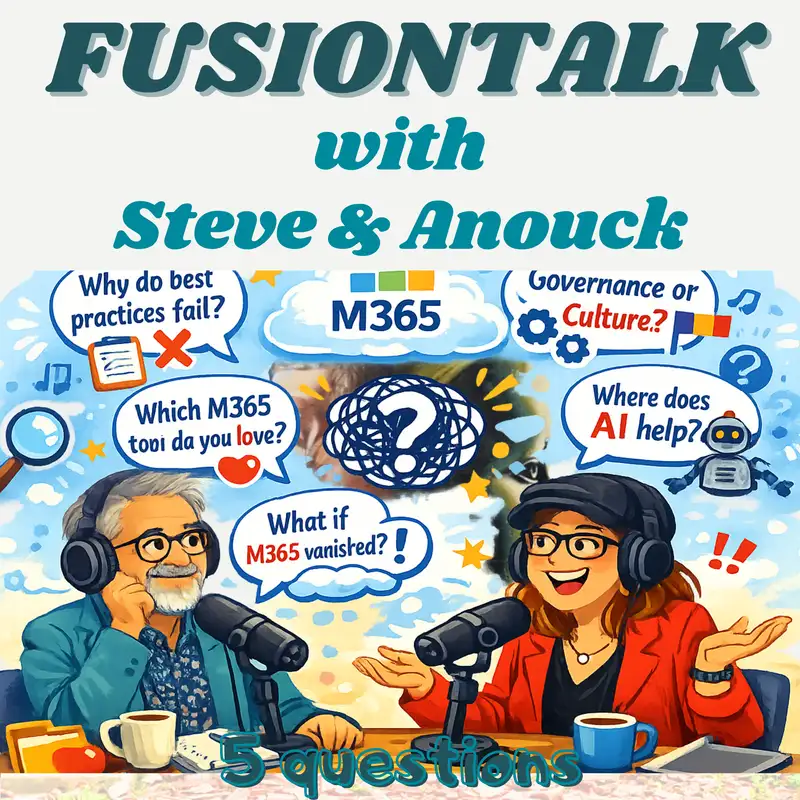
Steve: Yes, indeed they were cool though it was. And that brought me to the idea, why not create five questions each to ask the other one about M. Um.
Anouk: 365, our personal view of it, or position or what would we do if. That kind of stuff.
Steve: That kind of stuff.
Anouk: And you not only, of course, being a smart, intellectual, independent woman, had how many questions?
Steve: Uh, way too many.
Anouk: 20, I think.
Steve: He said something like that. Yes.
Anouk: Damn. And you don't know yet which five ones you're asking?
Steve: Um, no, I don't.
Anouk: Well, we'll see. All right. And the point is about getting personal opinions about how we feel about the questions, not just answering yes or nos or anything.
Steve: I don't have, uh, yes or no questions.
Anouk: No. Neither do I. This will be fun. All right, so, ladies first.
Steve: When did you realise that best practise doesn't always survive contact with real users?
Anouk: Oh, when did I first realise it? I have such a big career to think about. That's an unfair question.
Steve: It's not an unfair question.
Anouk: When did I first realise that best practise was not the preferred usage for end users? Oh, I know. Oh, best practise. So when I first started my career in 1776. All right, um, many years ago, before computer, before the PC was invented, I have a badge that says, I'm older than the Internet then the. Everything was fairly process driven, so that was the only way it would kind of work. And that, I guess, at that point was the definition of best practise. So best practise wasn't, you know. Know what 7,500 people had found the easiest way of doing something. It was called, uh, technical instructions ti. And it was very reminiscent of IBM's dictionary terminology. Have you never heard of IBM's dictionary? No. You weren't. You're too young. So IBM used to have ways of describing everything in their organisation. Yeah. All their computers, everything that goes with it. But it also extended to how the computer rooms and their buildings were built. So for example, they had a one page description that described what a window was in a wall. All right, uh, no word. It was one of those silly emails when emails were invented that used to get circulated around and in British Telecom we used to have technical instructions and they would tell you how to do something.
Steve: Yep.
Anouk: And I think that's probably my earliest recommendation or earliest recollection. Um, it's the word I need, uh, of uh, being told how to do things one way and then being shown how it actually gets done.
Steve: Yeah.
Anouk: Um, my own personal um, example of that I guess when I was younger, um, uh, was cabling out buildings in the days of putting, when every telephone actually had to have a wire instead of a radio. And so you would, you would cable out an office block for telecoms and you would have you know, a, ah, 200 pair cable starting in the basement and it would run up to each floor and then you would connect into a box and you would then connect some up and you would connect some up and then you would have a different cable that goes for each along each floor and then you have another distribution box and a different cable. And I remember once um, having a job to do and I was doing it on my own, I guess I was about 22 or 23 and um, I decided that wasn't the best way forward. So what I did was I ran the 200 pair cable all the way around the office. I didn't make even right to the end. No, not quite right to the end, but to the last distribution point. And then I just used to, I slipped the cable and pulled out the ca, the wires that I needed. I didn't terminate it, connect it and then connect individual cables. I just took the first 20 pairs at the first point and then I took the second 20 pairs. Even though they're still in the cable, they're now cut off and not connected anymore. And then my boss came and see it and he went why have we never done that before? Well that's because the rules don't allow it. But it basically stopped us right running 7, 8 lots of cabling when we could just do one cable, which is where all the time was. So I defined a new best practise.
Steve: Yes, you did.
Anouk: So I guess it's getting those instructions and that for my. And that's changed my life in some Ways because I do not like, I'm not blue, I'm not a run by the detail kind of guy. People, uh, know I'm an agile thinker and creative stuff. So uh, when I look at a job, I, um, have to do it that way.
Steve: Yes.
Anouk: I've got another example as well. Um, but this is one where I learned because I screwed it up. So, um, um, how do I explain this? So if you imagine that you've got 40,000 people with a telephone, okay, and all of those 40,000 cables go back to one building and in that building there's a, uh, uh, active components for doing the voice switching and a telephone exchange. And all of those cables terminate on a big long metal frame, hand round and terminated. And I had to change over a whole telephone exchange from one rack to another rack in a different building, okay? So to a different new exchange. So we connected them together and everything else and to. And I aimed for 100% accuracy. So basically I had one person at the end of every and they were connected together and one said, okay, I'm doing the first pair. Now you would test the first pair, then they would disconnect it and they would test the new cable. Then they would wind it on and then they would wind it on and then that would be done and then move on to the second pair. And of course it was just taking ages.
Steve: I can well imagine ages.
Anouk: It really was. And I was aiming for quality, but they wanted to know why I hadn't done it in three weeks. And when I told them what I was actually doing, I mean, I think I was 19 or 20 when I told them what I was doing, they went, has nobody showed you how to do this properly? What do you mean properly? No, just, just ignore the quality. Just get the wires changed. Because nine times out of 10 there's no phone call on there anyway. So rather than checking, just do it.
Steve: M. Yes.
Anouk: So that was another learning experience. Yeah, I never forgot that.
Steve: So best practises are good and give you a guideline, but at the end you will find another way that is maybe better or easier to do.
Anouk: Well, I think constant improvement is important. I was talking to my boss the other day and I was checking everything was okay and he went, nope, I can see you improving all the time and changing stuff. Even at my age, improvement is mandatory as part of the role, uh, doing things better and more impressive, especially with AI I mean, we've mentioned it now already. We're already eight minutes in and AI has been mentioned. So, uh, AI is going to make those changes. So you, you need to really, truly understand where those things are going to happen. So true. It's going to be quite cool. Good answer.
Steve: Always a good answer. Crappy question, There are no good or bad answers.
Anouk: Yeah, okay. Um, all right, then. So which one shall I go for here? All right, which M365 app or service, application or service is your true love? And why not what makes you the money necessarily, not what you necessarily enjoy doing, but something which application is the one you're passionate about?
Steve: Then I will stick with SharePoint.
Anouk: Interesting.
Steve: Yes. Um, why? When I was, uh, doing my study at College, we get SharePoint in our study, so we learned to work with SharePoint and programme against SharePoint already at school. And there started my fascination for it and my interest in doing more with it, because you saw what it could be doing and what it could create for a lot of people. So SharePoint will be always my number one tool to work with and to do, because it's a passion, it's not work. I do like what you can create and how you can create things.
Anouk: Okay. Um, how many people were in the class doing the same course?
Steve: Uh, we were with 45 people.
Anouk: Jesus Christ. Anyway, so how many of them feel the same way about SharePoint or felt the same way about SharePoint? Did many people understand it like you did? Because obviously you saw it and went, wow.
Steve: Yes. Uh, we end up with 30 of them that are a SharePoint. Started a career with SharePoint, really, as a consultant, a developer or even involved. Yeah. So there were a lot of people. And so I think that's also a good point that our teacher at that point in time, uh, she came from the business, so she worked with the tool before she started teaching it. So she had a passion for it and she was very good in bringing that passion over to people.
Anouk: It just shows that if you have a good teacher, they can pass on a lot more than just instruction. Um, and I know we do a lot of evangelism. Well, you do. I don't do so many now, but evangelising the products, um, and I can imagine that has the same effect. Really.
Steve: We had one funny storey with that. Ah, one, um, teaching SharePoint at school. So our computers, we always need to change discs in it, so hard drives. So you had a personal hard drive for the entire year and you need to change that into computers.
Anouk: Wow. A plugable hard drive.
Steve: I guess. Yeah. And so when we needed to do our, um, finals and we needed to do our exam programming on SharePoint, she brought wrong disc with her. So all of our exercises and all of our previous codes were on there instead of the rebooted one just for the exam.
Anouk: Oh, wow.
Steve: And she noticed that. But someone. So she stopped the exam. She rescheduled it. So we did it at another time.
Anouk: Nice.
Steve: So, yeah, it was fun.
Anouk: Um, Nice. Okay.
Steve: Okay.
Anouk: What do I go with now?
Steve: Uh. Oh, you need to wait a little bit.
Anouk: Why? Is it your question?
Steve: Mhm.
Anouk: All. Uh, right. I wrote one. Sorry. You see, too many questions. You've got no idea which one to choose.
Steve: When did you last think we built the right solution but nobody use it?
Anouk: Oh, it's easy. You know, um, we built that, um, uh, card on the, on the website. We're supposed to let people know when something's failed. Nobody has ever, ever put. It's been sitting there on the homepage and marketing has slowly moved it further and further down the page because it never changed. So the service desk was supposed to put on there. This issue is not working. No.
Steve: Why don't you just remove it then?
Anouk: Stubbornness.
Steve: Hoping somebody will ever use it.
Anouk: Well, I can make them use it. I can tell them to use it. In fact, I had a conversation this morning with John and we were talking about our incident management process. Um, and this week has been an interesting week. I think we've instigated the incident management process three times since Sunday afternoon. I mean, it's been one of those weeks. Silly, silly things. One of them was a faulty, um, memory chip in a laptop. In a server. Um, and what was interesting, we're booting up this database. It's running. Yes, it's running. This database is up and running. Yeah. Connecting. This one's running. Connecting. This one's connecting. Oh, it's crashed. And it was that. What was happening was the memory was getting full, full until it hit the faulty memory and then just dying. And then I had a, uh, server that was updated and then wouldn't reboot and one or two other things. It's been an interesting week. So. But we were talking about the fact that we have this process and we're using bits of it, but we're not using all of it. Yes, I think it's easy. And I spent three days with, with one of my other colleagues and we worked our way through the whole process. Should be. We, we put a process in place but we don't use it. So we were talking about how we would do that.
Steve: So something with best practises.
Anouk: Well, you gotta, you gotta be. You've got to work out what it is you want to do. And uh, because you can't be too detailed, because you have to be flexible. Yes, but um, but for example this faulty memory chip because it was a Sunday afternoon and I didn't kind of want to wake up the whole team, um, um, we carried on looking at the database as a problem. We did not at that point look at the hardware as a problem. As soon as I brought uh, my hardware guy in, uh, and uh, the MSP for the hardware, they went, oh, you got a faulty memory dimm on number nine. And so then we wasted an hour and a bit doing at that point in time. So the processes are important. So what was the last thing I built that nobody used? Yes, it was that uh, widget, for want of a better word.
Steve: Yes.
Anouk: Shame. We are thinking of how we're going to do this, but we don't think we'll end up using that. I think we'll end up using Engage or something.
Steve: That's a uh, favourable reason to fair tool to use it as well.
Anouk: Yeah, it is. It's the right thing to do. So there we go. That was a great question. I like that one. What am I going to do for you now then? All right, so um, a client phones.
Steve: Yes.
Anouk: All right, so this is a you question, not a technical question. A client flows and describes a project that will, you know, it'll give you say six months work. So it's a sizable piece of work, one that you're going to rub your hands at and you want to get going.
Steve: Mhm.
Anouk: Okay. And they describe what that project is going to do and it's going to deliver. Okay, what kind of project would you immediately refuse to get involved with? It's going to pay you a lot of money. The client's telling you what it needs to be done but you instinctively decide to refuse it.
Steve: Um, for me, that will be the projects that are also involving a lot of Purview or Azure or anything else.
Anouk: Because you don't know about it.
Steve: True.
Anouk: So any project with technology you don't know about, you would instantly refuse.
Steve: No, because if it is small pieces in those technologies, I'm happy to work it out. But if it is by example, this.
Anouk: Is a bullshit answer you're going with. If I don't know it, I'm not going to do it. No, I'm going to re. Answer the question.
Steve: I'm going. I said if I. If it is a lot of what.
Anouk: You said, but uh, I know where you were going with it. It's a crap answer. So I'm going to change the question. So. So what project? All right. From a client that you are technically capable of doing. All right. Would you refuse and why now? You've got to think, haven't you?
Steve: Yes.
Anouk: Because the other one was a cop out. Answer anything I don't know about, I'm not going to take on board. That's an ethics question.
Steve: Um, I, uh, will. Timing will be one of those important things in it. But what project would I refuse? I don't know yet. I really don't know what I would refuse. Maybe not refuse, but maybe say I need some hands on. I need somebody else in the team because it's too big for me alone.
Anouk: And uh, no particular technologies that you work with you will turn down. So you would take. I have to say, uh, I do understand where you're coming from. For somebody that's just done a migration of or setting up a 14,000 SharePoint sites on one project. Yeah. It would be difficult for you to turn anything down, I guess.
Steve: Yes.
Anouk: So you don't refuse anything.
Steve: Based on projects? Uh, I don't think so. No.
Anouk: You've never refused anything?
Steve: Uh, I refuse because timing wasn't right. But that's another reason to refuse. But.
Anouk: So every tech you run with.
Steve: Every technology that I know. No.
Anouk: Okay, so if a project's about a technology that you understand but you don't want to work with, what would it be?
Steve: Uh, Java of PHP project. Yes. I received those questions and I said no to them directly.
Anouk: Interesting.
Steve: That's not what I want to do. But if it is Microsoft 365 related, then that needs to be a very good reason not to do the project. And I can't think about one reason at this moment in time.
Anouk: So basically your days of uh, what you call a developer because you keep telling me you're not a developer, so that really is behind you. You just wouldn't go anywhere near it anymore.
Steve: True.
Anouk: Okay.
Steve: Only it's fun projects to develop. Then I will uh, for my own. So.
Anouk: What did you write me new app in I saw that it was actually on a. On an app development platform. Did you vibe it or did you.
Steve: It's Vibe coding.
Anouk: Yeah, you vibe coded it. You didn't tell me that. I thought you were smart and clever and you did it yourself.
Steve: I could programme it myself, but then it will take me a lot more time than what it is now. But it's vibe coding.
Anouk: Yeah, first one you've done.
Steve: First 1:5 coding app that I've done.
Anouk: And not the last I'M guessing probably not.
Steve: I will have lots of ideas to do.
Anouk: So it'll be interesting to find out how you then start to make those changes we talked about doing. Yes, because I'm interested how Vibe coding does that. I mean, it's easy enough to say, hey, I would like an app that I can scan this and then I want you to go and find this and then I want you to display it this way. That's a kind of nice way of prompting something.
Steve: Yeah.
Anouk: When you want to go back and add a different resource for it to scan and you want to try and do that as a prompt, you kind of got to have some hooks to hook it into to. Yeah, that will be the interesting one.
Steve: Yeah. It's going to be fun to do it as a first version of what it is. First version of the app it creates.
Anouk: It is.
Steve: It's very fun and it will help me a lot in the future, and I hope so also other people.
Anouk: Are you ready for your first sales meeting tomorrow?
Steve: Uh, let's first make sure that the meeting is about my health before it turns. A sales meeting with the doctor.
Anouk: Oh, well, yes, that will be fun. Cool.
Steve: Yes. Uh, would you rather help an organisation fix its governance first or its culture around collaboration?
Anouk: Is there a difference?
Steve: That's the question I'm asking you.
Anouk: It's not. You're asking which I would go first, but I don't think there's a difference.
Steve: I think there is.
Anouk: How now? Okay, just my question. All right, let's describe the differences. So, governance is a description of how you would use a application, our user would use it, and the limits of what they want to use to protect the service or to ensure that the company is ethical. Setting the culture of a company is, uh, getting the people to change the way they work, uh, in a way that, um, ingrains those changes throughout their organisation and process, which in today's day and age, by the way, is nearly impossible to do because nobody is willing to put that amount of time and money into it to do that anymore. So how can you change the culture of something if you haven't decided the governance? So let's take those into another option. So let's assume that I don't do the governance. Uh, I set up a new tenant without configuring it. Connect everybody in and say, hey, you can use any of these applications. We're going to move to the cloud. Here's some training. Hey, this guy. This is great. You can share the shit with anybody you want. Um, your emails are going to come and you're gonna have the greatest applications. How much of a risk would that organisation be in? High risk nowadays especially, especially with AI mail shots and all that kind of stuff happening. So, um, ethically would I want to go in and change the company's culture? Yes, actually if I had a choice, I would absolutely want to go do the culture thing. There's no doubt about that. All right. To actually have the free rein to do that. Yeah, I have an organisation I'm going to work with um, to do that. But of course it's a very difficult organisation to do and they don't have hundreds of thousands of euros for a five year project.
Steve: No. And also, um, changing the culture is moving them from um, a we transfer or a Dropbox or a box.
Anouk: That's changing the way they work.
Steve: But not the culture, the culture about collaboration. It's the way they are working now because there is nothing set up for them.
Anouk: Okay, I get where you're coming from, but I see culture as a slightly different thing. I see the culture of the people, uh, not about this is how I do X and this is how I do Y. Yeah, I see it more about, hey, this is what I've got to work with now. I can do anything I want. All right? I've got so much more choices and things that get me. So my view would be, I'm not telling you how to, to do something. Uh, I'm telling you these are the tools. So how would you use those tools to do something? And that's the cultural changes you now are not limited to do that. And that's why I say you have to have the governance done. So we do a session on the 10 governance rules for um, Power Platform which we're doing. Do you have the top of your head where we're doing that next in, uh, Vienna. Vienna actually in two weeks time.
Steve: Yes.
Anouk: So. And one of the things that uh, I talk about there when, when it gets to my sections is that I want people to just go into power, automate and do what they want. I want that culture of innovation to do what they want. But all right, I don't want it to be a sprawl of problems and stuff everywhere else. So we have to have some controls in their place. So if I had the choice to do one or the other change the culture, but I equally, if that means that governance doesn't get done, then I would have to do the governance. But if some, if there's two of us there and there's governance to do or Culture change to do. They're doing the governance, I'm doing the culture change. All right, I like that question. Great question. Nice. What do I want to go with here? I got some AI questions, but I keep wanting to put them off. All right, let's change. Let's go to the last question. The last question I asked you what project you would never, ever do. Okay, so describe what your absolute dream perfect project would be. So tell me what the scope of that project would be.
Steve: Um, the scope of that project would be. Some SharePoint stuff, of course, because that's still what I like. Um, that can be from setting up SharePoint to building something on it. But next to the SharePoint part, I also very much love Power platform. So that would be a combination of.
Anouk: App and again, you don't answer the questions asked, do you?
Steve: But the scope of it.
Anouk: It's the scope of the project. It doesn't matter what tools you're using. What about the scope? What will it deliver? What's the dream project?
Steve: It's difficult.
Anouk: Would it be, um, uh, absolute project, unlimited budget, to drive collaboration in an organisation? That's what a scope project would be. The project to do the, uh, to replace, um, all of their normal production processes with PowerPoint workflows. With, uh, Power Automate.
Steve: Power Automate workflows.
Anouk: I mean, interestingly enough, I guess now having thought about it, mine would be that one we just talked about earlier where change the culture of the organisation to use M365 in an absolutely brilliant way.
Steve: I think it would be something with, um, transforming their user request forms into Power apps and sending it to. With Power Automate within approvals, ah, updates of Data, uh, to SharePoint.
Anouk: So some kind of really complex workflow that is used by everybody in the organisation.
Steve: Something. Yes.
Anouk: I don't know how to respond to that because it sounds really nerdy and whatever, but I get it. So that would give you a lot of satisfaction. That would be your dream project. Not designing SharePoint pages for the largest intranet in the world?
Steve: No. Because if you design pages, it's always the same.
Anouk: Not really. I mean, one of my. The best intranets that I never built, uh, included all kinds of really, uh, cool, imaginative things. So like, um, it was a company that had sales competitions and they wanted a racetrack built on their intranet so that they could feed in the sales figures of the top salespeople and people could go and see where they were on a race circuit to see whether they were in the lead or at the back. That would be a Cool thing to develop into an intranet.
Steve: True.
Anouk: So building a workflow is a bit bluish.
Steve: Yeah. It's still the little bit of the developer that isn't me.
Anouk: The bit that you don't want to admit to. Yeah. Yep. Uh, okay.
Steve: What is the one thing you wish Microsoft 365 consultant talk more honestly about?
Anouk: Oh, that is an interesting one. Is there a bit of a context? Talk to who? Talk to each other.
Steve: To each other. To their customers in general.
Anouk: Oh God. This is a good question, isn't it? What would you wish that M M365 consultants talked more honestly about? Oh, there's so many things in my head.
Steve: I knew this was, was perfect for you.
Anouk: How about. The right way to implement Content architecture? So we have mentioned a number of people that we work with that are so called SharePoint consultants that have no idea what content types are, that have no idea, um, about the implications of, you know, multiple libraries on sites and no idea about Circ architecture and Graph and all that kind of stuff. But they go in there and just throw a library up and say, hey, this is how you SharePoint. So, uh, it would be about how content architecture is supposed to work.
Steve: Yes.
Anouk: Is that it? Just. Yes.
Steve: Um, I think so. Yeah. No, Um, I do understand where you are coming from because I see it in my job as well that a lot of people say, yeah, but we know sharepoints. We don't need you to explain it to us. And then you ask a question and they can't answer it.
Anouk: They m. Basically the other day he, um, did some training, uh, and sat, uh, down and said, guys, okay, how you doing there? No, no, no, we use SharePoint. We got it all the time. We use SharePoint. So he said, so what do you do with it? So look, it's here. So they opened up Internet Explorer and said, you see this? This is our SharePoint site. All we do is drop the documents in here and we edit them here. Perfect. And so when he said, but there's a website behind that, they went, what? The website behind that. And there's a load more stuff that you can do. They had no idea. And that was because the person that had put it in had done the bare minimum. So when it came to his training, he's going, okay, let me show you what SharePoint really is.
Steve: Yeah, but I was working with somebody and he was the SharePoint expert in the company. And we were talking about that's a specific field. And I said, yeah, but that's calculated field. Yeah, but we need to be able to change it. But that's calculated, it's coming from other data that you are filling in, so we can't change it. Do you know what a calculated field is?
Anouk: So, yeah, this should be, uh, an entrance exam. To be honest, I do understand it and I don't think it's the consultant's faults necessarily. It's just that they're allowed to get away with it because the customers don't understand what it's capable of. I often wondered what the statistic is around, um, how many people. For example, we know that content architecture is about, uh, three things. It's um, about the audience, um, it's about search and it's about tagging every document with the appropriate content so that the right audience with the right terms can get to the right document. It's not just about, I'm on this site, therefore I know doing SharePoint, I'm not really, I'm just putting a URL in. So we have all of those things. But I wondered, of all the hundreds of millions of SharePoint sites or SharePoint organisations or tenants there are, what's the percentage of them that actually use custom content types to manage their content, that use metadata to search their content? I'm 10%, 40%. No idea.
Steve: And no idea neither. But I'm helping a company out here in Belgium. They have still classic SharePoint sites, so they need to migrate to modern.
Anouk: Wow.
Steve: Um, yes. And yeah, we use SharePoint and the lady set it up correctly. It's a lady, she start as the admin, the owner, she created the term store, she created content types and the user said no, we are not using it. So they now have placed everything in folders and they don't use it anymore.
Anouk: Surprise, surprise. Microsoft just should remove the folder function. That would be great, but they don't have the courage.
Steve: That reminds me that I need to talk with another mvp.
Anouk: Okay.
Steve: I had a challenge for him. I would like to know where he is with it.
Anouk: Okay. All right, cool, cool, cool. So that was your question?
Steve: Yes.
Anouk: What was the question that seems. I can't remember it. What did you ask me? What did you just ask me?
Steve: Um, what you want more Microsoft 365 consultants be talking more honest about?
Anouk: Yeah, content architecture? I think so. Um, but that means we have to educate the consortiums. Okay, we're going to go into the world of imagination which in your case, because you're a developer, uh, don't have. But that's fine. So, um, I'm going to save that question. How Many questions. Where we at, by the way? How many have we done?
Steve: I have one left for you.
Anouk: One left?
Steve: Yes.
Anouk: Oh, then maybe I need to choose one of the others. All right, I'm going to go with one of the AI ones and then I might come back to this one. We'll see if we go which application in Office 365. So we're talking Office 365 now. Yeah. Not M. Um, 365 Azure or, uh, Workflow or anything along those lines. So application from the long list under the waffle. Right. Would AI make the greatest improvement as a replacement? So if, for example, it was PowerPoint, you wouldn't have any commands to put in. You would just sit there and describe the presentation you want and it would then just get created. You may feel that that is the best replacement that AI could make. So what application in O365 would AI make a great improvement with? Best improvement, biggest improvement as a replacement.
Steve: Tough one. There are so many applications. Which one do you all have? We have, of course, the Office applications. We have SharePoint teams, Loop OneNote planner, projects to do.
Anouk: Whiteboard.
Steve: Whiteboard.
Anouk: Co pilot. Let's have Copilot with AI. That would work.
Steve: I think, for Kazana. Never used it. Um, maybe Designer.
Anouk: Designer?
Steve: Yeah. Where you can create images.
Anouk: What, the one that works with AI?
Steve: No, uh, not the designer. The Clip Champ.
Anouk: The video one.
Steve: Yes.
Anouk: That you get sleep time to start off with. So anything improvement is kind of. Actually, it's not. It's just.
Steve: It's not that easy. It's quite easy in use, but it takes a lot of time if you want to save it.
Anouk: And editing and it's the online capability. I just don't think video editing tools were ever designed to be online.
Steve: But I think if you can just say what you want to edit in your video, it will make life easier than just doing all of the steps for me personally.
Anouk: Okay. Interesting response. Fine.
Steve: Yeah. Clip Champ.
Anouk: Clip Champ.
Steve: Yes.
Anouk: Because the interface is crap.
Steve: Yes.
Anouk: Or difficult to use.
Steve: Indeed.
Anouk: I'd like to be able to see you write a prompt that would be able allow you to edit the video. So it would need to be really smart, wouldn't it? Where the lady walks through and puts her hand on the door handle at that point, cuts there and move towards a view from the window of the killer coming in through the back door.
Steve: Something like that.
Anouk: Yeah. Or at frame 67, I want you to cut it and remove that section of the tool. Frame 822M. Yeah, I don't know, a great question. What is it?
Steve: Yes, it was a good question.
Anouk: So what application would you would make a great improvement? I. I couldn't think about this myself. Um, I think that Excel is a real potential, but it's not there yet.
Steve: M. No.
Anouk: So I think what is really interesting is that, um, I was trying to get some statistics out of a ticketing system a few weeks ago and I could list all the tickets about a particular technology and there was 650 of them or something. Then I said export it as a CSV file, which it did. You put that into the spreadsheet? Couldn't even really read it. It was such a really, really. It had. So, you know, CSV is a text column and every. And I'm saying it to everybody else I know, you know, but you got a comma every time that lines up with the column. When I brought this into the spreadsheet, it had two columns, so it had text comma, comma, comma, comma. Then it had something else and then it had more text comma comma, comma, so it had two CSV files interlinked. So I couldn't really work out how to get this apart. So I just pointed it@chat GPT.
Steve: Yeah.
Anouk: And I just said. And I asked it all the questions and it worked it out. I mean, it was just really actually damn impressive. Um, so I honestly think that potentially. And I read a report this morning actually, where this weekend a lot of software companies, shares and stocks just collapsed.
Steve: Yes, I've heard it as well with.
Anouk: The, with the new Claude software that came out. Um, apparently it's going to replace nearly all of the legal and medical kind of tools, so same kind of thing, really. What I did with this file, it was able to tell me so much. And the real thing is, um, I trusted the information, but, you know, I couldn't validate it.
Steve: Yes, we trust AI.
Anouk: Yeah, that was interesting one. All right, there you go. My last question is. One last question each.
Steve: I have one last question for you. If Microsoft 365 was taking away tomorrow, what part of your daily work would break immediately?
Anouk: That's a fabulous question. And so you want to know which application and, um. Why.
Steve: Why is my phone playing up now? All right, sorry.
Anouk: Read me the question again then, because I'm now confused.
Steve: Which application if Microsoft 365 was taking away tomorrow?
Anouk: Oh, the whole thing.
Steve: The whole thing is going away. What part of your daily work will break first?
Anouk: Calendar, I suppose. I don't do timelines, so I would have no idea what I was doing, where and when and how.
Steve: Not communicating?
Anouk: No. I'm a talk with people, I go and find them and I was, I was, I grew up in a space where there was no thing else except a telephone.
Steve: True.
Anouk: So you just picked it up and you dialled the number and you spoke to somebody in the next office if you didn't want to go up the stairs or.
Steve: But you still have then all of the phone numbers in your smartphone.
Anouk: There is no smartphone.
Steve: Well, no, but now, uh, if Microsoft 365 is gone, you still have all the contact details. You can still find where people are sitting, you can still know where they are.
Anouk: So can I email them? Can I use Google Mail? So right now it's just an interesting question.
Steve: I think so, because.
Anouk: But yes, if I was thinking about work, which is where I use M365, I would be really screwed because my personal email is on there as well.
Steve: It's an interesting question because I wouldn't.
Anouk: Be able to operate at all.
Steve: No, I don't think we can operate without it, uh, because we are so used to it. But for people working in the Google space all of the time, that. And they take away Google from them. They are.
Anouk: Which we've done today. Google has been offline and having problems. Not all over the place, I'm sure. But.
Steve: No, but that is indeed one of the things, because we are so used to everything.
Anouk: It's rubbish though, really, isn't it? Let's be honest. So let's assume that all the email goes down, calendars go down, you walk into your office and your team is just sitting down with their feet on the table saying, well, I can't work. Why can't you work? I've got no calendar. All right, what is your number one priority at the moment? What are you working on? And they would explain that. Hey. Well, I have to try and, um, find out how we can answer phone calls better. Have you got the requirements? Yes. Fine. Is the account good? Do you know what you're doing? No. Fine. Well then get some pen and paper and focus on something that you know you have to do.
Steve: Then you still need to have pen and paper in the office.
Anouk: When you go down this line, you just sit there and say all the reasons won't work.
Steve: No, but yeah, I know where you're coming from.
Anouk: Don't know whether the question would have been by which application would you missed most? That might have been a more precise way of asking the question, which application would disappear? That would just stop you Working for the day. Stop me working. Hm, I don't know whether that's the best answer either. Which application would have the most effects on your ability to do your deliver and add value? Yeah, yeah, different question. All right, cool. So uh, what have I got here then? All right, let's do this one. This one might turn into an interesting conversation. Use your imagination. All right, so there's no limits here. Okay. And define a brand new application, all uh, Right. Driven in the M365 space, that would change the life of a user. Their work life or their comms life or their whatever. What in terms of imagination, application coming around the corner would change the life of a user. In some respects it's okay, what is it missing? And then what would I create? But. Or uh, what are people doing and how would they get better and what do they need? No limits.
Steve: Then we are again with what you said about the environment. You have the user, you have search and you have your data. So a place where they can store their data. They can't use any folder at all. They can't uh, upload a folder, they can't create folders, folders don't exist. And then they have, they define their labels they would like to have and then they would have help to fill in the labels on an easy way without thinking too much about it.
Anouk: So what you're saying is they uh, upload to the document or something and then all they do is write a list of keywords to help people find it.
Steve: Yes.
Anouk: And that's it. And then behind the scenes it does everything else.
Steve: Yes.
Anouk: Do we actually have that today? It's a great question. If you created a document library with just that one column.
Steve: I think the knowledge manager is willing to go there. But still you can't fill in existing labels. So if you have a, um, metadata column, an existing one already on your library, it doesn't fill that one in. So that's a miss.
Anouk: It doesn't?
Steve: No.
Anouk: So if I have sales chart, file label, already used.
Steve: Mhm.
Anouk: It won't use the same label?
Steve: No.
Anouk: Why?
Steve: It doesn't fill uh, that in. So it's create new columns that are those AI columns and then it will fill in the information in there based on the information it finds in the document. But if you have a type of document like the sales chart, you say it will not fill in that column.
Anouk: Okay.
Steve: So maybe it comes there, maybe, who knows?
Anouk: Basically you're saying a completely free way for a user to describe a document.
Steve: Yes.
Anouk: And then the system just does Everything else.
Steve: The system does everything else and make sure that it's easy findable for the other users.
Anouk: Yeah, I like that. Actually, It should be an application where AI asks you three questions about the document, which you answer and then it saves it.
Steve: Yeah, can be.
Anouk: Interesting. All right, cool, cool, cool. Well, that took 50, uh, minutes. Five questions each. Five minutes a question.
Steve: Yeah, but it was fun doing.
Anouk: Yeah, yeah, fun thinking of the questions. You have to use these questions in your training sessions. I use this technique, these types of questions when I'm doing requirements gathering. Hey, imagine that you have uh, something added to your email that.
Steve: Yep.
Anouk: And see what you get back. And so rather than saying what would you change or what doesn't work, which is effectively a negative connotation, is, you know, what would improve, what would be better? Uh, what application helps you most?
Steve: That's why you improve the studio with removing your screen.
Anouk: Yes. Interestingly enough, I now have a 75 inch screen, um, instead of one that was what, I don't know, 120 inch or something.
Steve: Yeah.
Anouk: Um, but this is uh, more focused and compact. You've still not seen it yet, have you? It's just a black slate as far as you're concerned. 2001 A Space Odyssey. You don't know the film, of course. No, but it's all about this black stone that's travels through space and from lands on earth and gets found and all kinds of stuff. It's a very surreal comedy. Was, uh, it Arthur C. Clarke? Can't remember this original storey. Doesn't matter. It's such an old film. They, they're in space. Okay. And somebody lets go of a pen and the pen floats away. It's in space. But of course, this was film is at 40 years old. They don't have the ability to do CGI or anything else. So this pen was stuck to a piece of Perspex that went round on a motor so that they actually looked like the pen was floating away. The kind of way they did the technology and the filming them to, to make it work was pretty. Actually.
Steve: Everything improved.
Anouk: Yeah, that's true. Everything did improve. We didn't do any questions on how would you improve. Maybe that's another podcast.
Steve: Yes.
Anouk: How would you improve the delivery of emails?
Steve: Um, I had one question on my list and I was, How. What is the biggest adoption challenge you have when you're going from a file server to SharePoint Online?
Anouk: Bloody hell.
Steve: And how will you improve that process?
Anouk: You know, we only had an hour. Okay, let's answer that question together. Next podcast.
Steve: Yes.
Anouk: That's a big enough question to brainstorm.
Steve: Around for an entire podcast, easily.
Anouk: All right, cool. Well, guys, hope you enjoyed this. Um, it was fun. Interesting, um, idea. Loved it. Thank you very much for the idea.
Steve: You're welcome.
Anouk: And, uh, um, when we had the first questions, though, on the back of that knife and fork packet, I had a beer with me that was definitely missing.
Steve: All right, Nobody stopped you for having something.
Anouk: No, that is true. Well, it is mid afternoon. I've still got some meetings to go.
Steve: So do I.
Anouk: All right, guys, thank you very, very much for listening. I, uh, hope you enjoyed it. Let us know you can get all of us. You know how to get all of us.
Steve: And even if you want the question answered like this, just let us know.
Anouk: Oh, that would be cool, wouldn't it? Yeah. Send in a. Send in a question. All right, guys, have, uh, fun. Hope, uh, life is good for you, and we will catch up with you later.
Steve: Thank, um, you.
Listen to FusionTalk using one of many popular podcasting apps or directories.