 Episode 43
· 21:33
Anouk: Welcome to Fusion talk with Anouk and Steve. Are you frightened of losing it?
Steve: Yes, sometimes I am.
Anouk: Because we don't put a lot of thought into them.
Steve: No, we don't.
Anouk: And they're easily changeable.
Steve: They are.
Anouk: So I wonder whether they can be owned. It's interesting.
Steve: Yeah. But, uh, are you afraid of losing it?
Anouk: I'm always afraid of losing it. I'm at that age.
Steve: I was not talking about.
Anouk: I know you weren't, but when I asked you the question, the thought went through my eyes. Um, not really, but I don't care. So I'm not a big copyright property owner kind of person.
Steve: No, you would do it, write it, or do it again. Every single time, starting from scratch.
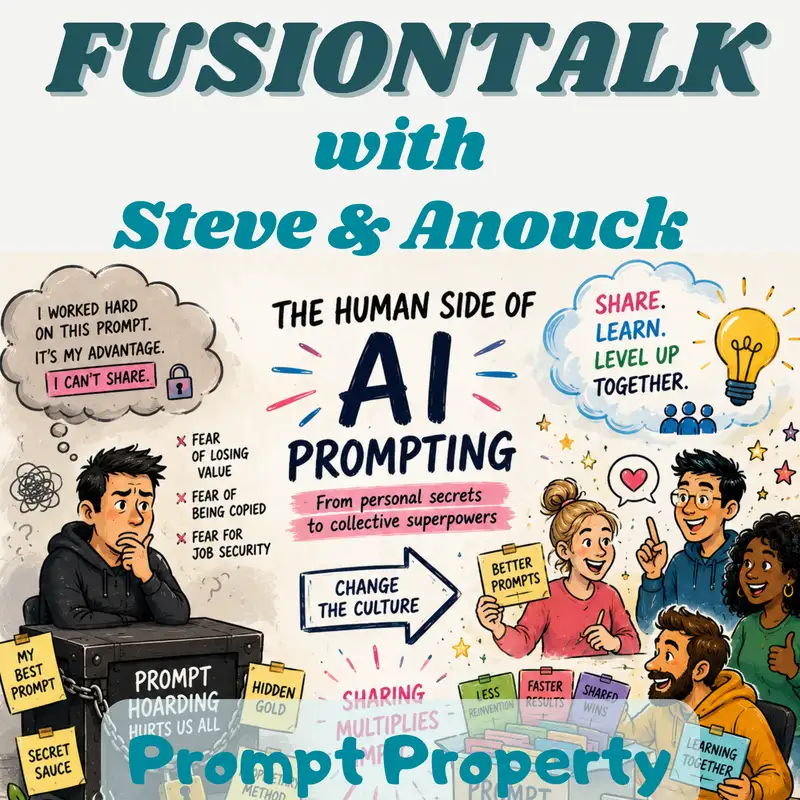
Anouk: That is true. That's the way I tend to work. So, yes, you're not wrong. So, folks, we're still talking about prompts. This is number three, uh, in our series, and we want to talk about the human side. So in episode two, we created a prompt library using a SharePoint list. Um, and I'm not sure whether we're presenting that anywhere this. Not this summer, probably in autumn maybe. But either way around, um, I'm sure there's a blog post about it. There might be.
Steve: There is. And if people are interested in, then just need to reach out to us and we can talk to them.
Anouk: But if you find a NUX blog site which is called 365 Anouk. That's so original, isn't it?
Steve: Yeah. Anyway, so, yeah, I have an ID to change it, but I didn't came around to finish off that id.
Anouk: I am not sure I would. You get such a good response. You need to think carefully.
Steve: Yeah, but I can change it to another domain and then send it from one to another domain.
Anouk: M. I will cheque with some SEO expert first because I got a feeling that can downgrade your stuff. But I'm. No, no, nothing. I know nothing. The theme of this podcast, this mini cast, I guess, because we're going to aim for, I don't know, whatever we go for is why don't people share prompts? Yeah, don't just say yes. Answer the question. Why don't people share prompts?
Steve: Because they are afraid of it. They don't want to lose the ownership of it.
Anouk: Power.
Steve: I think so as well. Yeah.
Anouk: Um, interesting.
Steve: They want to show off to their colleagues like, I have created this and I only had so much time to
Anouk: do it, but then that means they're sharing it.
Steve: The end result, not the prompt.
Anouk: Uh. Oh, the process, you mean. Yeah, I Suppose so.
Steve: So, yes, people are afraid of sharing things. It's the same like, um, I was doing a training last week and people were. Yeah, but I don't want anybody else working in my documents. When I'm there, it's my document, nobody else needs to do something in it. It's the same effect that we are now seeing with prompts.
Anouk: That's interesting. I never thought about that, but I don't think that way. But you're right. I mean, Knowledge is Power was the old, sort of 1990s, uh, byline. Um, but of course, who owns these prompts? I mean, I know we've got a number of discussion points, we'll go through them in a minute. But set in the context, if I'm working and I create something while I'm working, then generally it's owned by the person I'm being paid for, why I'm working, which is the company.
Steve: Yep.
Anouk: Even as a consultant, if you create a prompt, all right, they don't own it, but they have licence to use it so that you sharing it because they paid you for it as part of your. Part of your work. Like a script, for example.
Steve: Yes.
Anouk: Um, so in theory, the company can do anything they want with it. But people don't feel that way, I suppose.
Steve: No, they don't feel it. They are frighting of it.
Anouk: I again did a, A bit of a, ah, prompty, kind of advanced, uh, prompt workshop. But it was a little 30 minute. Wasn't really a workshop. That is such a grand word. I was part of a workshop, let's put it that way. And my nose is itching, so I might sneeze in a second. Just warning you, listener, if you're listening to this with headphones and I' halfway through, it might get a, you know, a blast. Um, we also have a background tape running just to make it sound like we're actually recording in the middle of a city.
Steve: We are recording in the middle of the city.
Anouk: I was not going to tell people,
Steve: so it's way too hot.
Anouk: Yeah. Um, if you listen to some Office365 distilled moraine and I also sat in my bar and recorded from here because there's big windows in all directions. Um, hopefully we won't have an ambulance or fire engine going past like we did for Moraine, or people arguing and papping their horns on the street, because
Steve: they're already doing that.
Anouk: So, yeah, we'll see where we go. All right. Um. So, yes, it's interesting. So prompts are value, as I was on this session today, um, the idea really was to try and to teach them how to use AI as a research tool, how to get the right kind of prompts, how to put context into your prompt. So, you know, because sometimes your prompt is specifically about a specific document, in which case would you put it in the catalogue? It's a good one. So. But. But that's like a hint more than anything else. But they were deadly silent. Maybe it's because I was presenting. I don't know what they'd done before or where they were at.
Steve: Maybe you need to launch this at your company.
Anouk: What? This podcast.
Steve: A prompt library.
Anouk: Um, maybe I do, but we don't have a big enough rollout at the moment. But I think it's a good adoption tool as well. So maybe we do.
Steve: You maybe don't have a big rollout because people don't know how to use it.
Anouk: Maybe. Well, I'm planning on doing something in September, so maybe that will be the case. So you think. Well, on our list of bullet points here, we've got fear of losing value.
Steve: Yeah. And I don't think it's fear of losing value for the prompt. It's fear of losing value for the person itself.
Anouk: Really?
Steve: People are afraid. Like, um, if prompts can all do all of this, which was part of my job, will they need me in the future?
Anouk: But do they not think that? I honestly think that's a really old fashioned way of thinking.
Steve: But it's still the way how people think.
Anouk: Seriously?
Steve: Yes.
Anouk: What a bunch of weirdos we have in the world. Yeah, but they're the kind of people that listen to podcasts about nothing. Oh, oops, did I say that out loud now? I guess it's true. I mean, at certain levels, of course. Um, but things did change. I mean, the 90s, it really wasn't about what you know, it's about what you know. How so just because you've done the same job for 30 years, they want you to be. It's about what you learned from that. The ability to learn and to move on. And that's why I find it a little bit strange. But I think the reason is not necessarily about fear. I think it's because they don't have a prompt. Libby, for example, to actually have, uh, you know, a place to store those prompts and keep them, like a password manager, you need a prompt manager.
Steve: Yeah. Can also be the case. I think we just need to ask people around us why they are not
Anouk: sharing it, because I don't think they think about it. No, I think that's the biggest thing. I think you need to create a culture of sharing prompts. Um, if you find something works for you, then tell the rest of your team kind of message. But that's fair is, um, humans are weird people and they are the ultimate
Steve: definition of chaos and especially if they are like you.
Anouk: You know, if I could argue with that, I would, but I probably can't, so I won't argue with that one. That is true. So I guess that leads on to the second one, which is really meaning the same thing. Personal productivity secrets. Why somebody does. Well, I really want to hope that human beings don't think that way. I do, but maybe they do.
Steve: Hopes keep us alive. Yeah, maybe personal productivity secrets. Um, I think it's also more about yes, I'm using AI, but I'm maybe not using toll that I am allowed from my company.
Anouk: Oh, yeah, Maybe they're asking about their shopping list rather than their company work. Well, yeah, who knows? So one of the things that I've got to start monitoring is the, uh, the prompts that are being put into Copilot. It'd be quite interesting to see what I. What I find.
Steve: And not only Copilot, but I am, um. A lot of people are using ChatGPT or Claude and they are not, maybe not allowed in their organisation. And that's why they say, uh, personal productivity secrets because it keeps them productivity productive, keeps them awake, aware of what they are doing and they are doing a great job, but they don't want to share with the organisation that they are using the tools for it.
Anouk: Yeah, yeah, I won't disagree. People, weird things. Humans in the loop. Humans in the loop. I do think though that within teams, teams tend to share most things. So you stand more chance kind of sharing things within a team than with across the organisation, for example.
Steve: Yeah, that's for sure.
Anouk: Um, so I guess you could end up with a local prompt library, not a corporate prompt library. And then all you have to do is synchronise it.
Steve: Yes.
Anouk: Roll it all up, make it a content type. Then they have no choice except they. Access will be a problem. That's true.
Steve: Yeah. Access then will be an issue. But if you start locally, then they maybe see or somebody of the team is going to another team, which happens sometimes.
Anouk: True.
Steve: And then they are, oh, but where's your prompt library? Where is your prompt library? Or oh, oh, you have the same. We have. We had the same kind of prompt. So maybe somebody else in your organisation has it. So let's work together. To improve it.
Anouk: Yeah, yeah. So, so we kind of started off on the problem, live really in the human side of that, which is all well and good. Um, but the point is that this is about humans and humans are all different and their prompts will be different, their priorities will be different, they will think of asking for information in different kinds of ways. So there's so much of an opportunity here for humans to share this information and actually improve the value that the
Steve: prompts are doing and learn by themselves. Uh, correct.
Anouk: Continued improvement.
Steve: Because it's not because you write a prompt or you have prompt in mind and somebody else has a different kind of style for his prompts that that style is better or worse. No, you can learn and you can bring both of best of both worlds together.
Anouk: Yeah.
Steve: And that continuous learning is sometimes something we see, or I see. An organisation is going. Pushed to the back at a moment in time.
Anouk: True.
Steve: People think AI will fix this for me or AI will help me out and they don't want to understand it or learn from it.
Anouk: No, there's certain, there's a lot of truth in that. I think that, uh, they worry that they're going to put these things into AI and it will learn how to do my job. Those that really sort of are not thinking properly and fairly around where they're at. I think other kinds of people have worried too much, as you say, about personal knowledge and, um, keeping my job. So that is, to an extent. So the human side of things, though, adds variety and, you know, if it is shared and if it is fed back properly, then it provides improvement, natural improvement, to, uh, get better results from a particular kind of prompt.
Steve: Yes, I agree with you.
Anouk: What, are you allowed to do that?
Steve: Uh, yes, I think so.
Anouk: Do anything you like. I like it. That's all I got. But what's interesting today, going through this session and listening, looking at blank faces and realising that, you know, they may well do a bit of a prompt. I asked a question. So, um, this is a group of people that are going to be doing analysts and, uh, power BI people or BI people. Not necessarily power BI people, but BI people. There are people that are going to get affected by AI in a really quite significant way. So it's not developers, but it's more business analysts and more, um, um, business information people. So the idea was that I was going to do a session on how to, how to work with prompts for large, super large documents. You know, if you got a large complex project to build or a piece of work that you want to Describe or document. You're not going to be able to do it in six words on a prompt. Um, but. So I asked that question. So I said, guys, look, I need to create a, uh, whole project outline here, or workspace outline for setting up a voice system for a company that's got 20 offices around the world. How many people think you can do that with one prompt? And three people put their hands up. Three people put their hands up. Basically implied that they'd never really used it or thought about it.
Steve: No. Wasn't that better? Your opening question. Who have ever used AI for doing their job?
Anouk: No, because we're promoting that. The point is that they're. This, uh, this thing was about trying to get them to improve their. Okay, their usage of AI. So I have no qualms with, with that being what it is. But it was just interesting because I expected them all to have used it. And in fact, what's really cool, because Kuhn, who heads up this, uh, this group, um, uh, worked with, uh, the kind of, uh, AI people in the company to set up a bunch of AI tools all driven by Copilot. So they connected copilot to ChatGPT, um, cursor, um, Rovo, uh, which is our Jira AI copilot itself. And something else. Uh, oh, the local MCP server, because we have a local NCP server. So you can all do it from one central point. But, uh, and that's quite cool because security got involved on making sure it was safe and secure and uh, that you couldn't actually get from the beginning to the end using the same account. So that we were separating things off and we were, um, network segregating, uh, MCP servers and then deciding what they can and cannot talk to and what accounts they were using. So it was quite a good exercise setting it up for this special workshop today. Um, and uh, I don't know how the workshop's gone. They were busy this afternoon creating problems and doing whatever they were planning on doing. But what was interesting was as I was sharing my screen, everybody was staring at theirs. You know, they really were watching. So it's, uh. There is a lot of learning to be done around the human side. I think there's some nervousness about it still and new skills.
Steve: I also think it's a little bit, um, it's new. People don't know what to expect. It's not that new anymore, but a lot of people still don't know what m. To expect. So I don't think they all trust it like that or they all want to uh, use it because it has
Anouk: a good amount of trust.
Steve: The um, unknown.
Anouk: Because of the unknown. Yeah, but they don't bother to go looking for it. I mean find an AI chat and ask AI. Yeah, that's fine. So I think there's some value then in sharing it more and more as humans because there's got different styles and get different results and you can learn from somebody else's prompt and go, oh, that's how they do it or that's how they do it.
Steve: And also the way I would set up in your company, uh, with Copilot, Corsa, uh, and the other AI tools, every tool asks for another way of asking things sometimes.
Anouk: True.
Steve: So it's also a learning experience.
Anouk: Yeah, but that's the same as using a laptop and using an Apple device and ah, all that kind of stuff. So I think that uh, uh, uh, luckily enough we're in it so we would suspect most people are used to it. So that's cool. So humans, are they still doing the same thing or do you think that the whole prompt process will mature? Because if they don't want to share it, if they don't want to get into uh, prompt libraries, if they don't want to do this, then they're going to struggle to mature from an AI perspective.
Steve: Yeah, maybe at some point they will have suggestions. Uh, like if you search for something it's giving you also suggestions. Are you searching for, do you mean this or did you mean this? So maybe that's something that will come with the prompts.
Anouk: Maybe difficult to know. Yeah, it is difficult to know but I think that those that want to mature in AI will and those that
Steve: don't, they will stay behind.
Anouk: Yeah, it's uh. So but as an organisation, should we let them hang around or stay behind? Should we not actually be doing as much as we could to encourage them to use AI and understand how it will add value to their job?
Steve: I would say encourage them to use it and to see how the value is being added. But I also understand that a person that is a uh, half a year of his pension is not going to invest in it anymore.
Anouk: True.
Steve: So you need to look at the person you are talking about and um, the goals they have in their career because if they don't want to change anything, maybe they don't need to mature in it.
Anouk: No, everybody's going to need to mature in it one way or the other. There's no doubt about it. So we started by asking the question whether a uh, good prompt is actually organisational property and whether humans see it that way. I think the bottom line is they probably. They don't see it that way at the moment.
Steve: No, they won't.
Anouk: The same ways they don't see their email as being owned by the company.
Steve: True. So there is a lot of learning from human sides to where this is all going and to communicate and collaborate about it.
Anouk: Yeah, I think it's more than learning though, isn't it? It's about, hey, the human side, what it learns from it, how it improves, how it does what it does. But there's also a bunch of stuff around the governance side about what the humans are allowed to do and how those systems can be protected. So I think that those humans that are bright here realise that they'll go a long way by really understanding AI. That's the important message I think, to take across is, you know, if you don't do it, then try it. At least, you know, understand what's happening to an extent. Be ready for it because it will hit you in the future.
Steve: It will.
Anouk: Cool. So there you go, the human side of AI prompting. Short and sweet, kind of. Yeah.
Steve: Interesting as well. Trying to understand humans, how they think and how they work. Yeah, always interesting.
Anouk: That's true. So if you have any thoughts, you can reach out to us, you know where we are. Uh, various locations.
Steve: Yes.
Anouk: Various places. So give us a shout out if, if this is adding value. Uh, and, uh, what's the, uh, what's the next episode about?
Steve: Governance. Oh, boring versus creativity.
Anouk: Oh, exciting.
Steve: Yeah. Governance. Burning creativity is going to be fun.
Anouk: Yin and yang. Cool. Hope guys enjoyed this. It's a goodbye from me.
Steve: Bye,
Anouk: Sam.

Listen to FusionTalk using one of many popular podcasting apps or directories.