 Episode 44
· 16:45
Anouk: Welcome to Fusion talk with Anouk and Steve. We have been a naughty boy and a naughty girl.
Steve: Why?
Anouk: Because it's been such a long time since we recorded these podcasts.
Steve: It is.
Anouk: We have these great ideas. Let's do five quick podcasts, relate them in quick succession, and I think by the time with comms, verse, TV and all the other stuff, this is the first time in four weeks we've had a chance to do this.
Steve: And you know that we still need to mix down everything of Hamburg.
Anouk: I'm aware. And I took them to the UK with me this weekend, but then I'm so busy. Oh, I went to see so many cool things and see. Meet so many people I haven't seen for so long.
Steve: Yeah, that's important as well.
Anouk: It is, it is.
Steve: Having fun in life.
Anouk: Absolutely. I need to water me plants as well, although they seem to have survived. Okay. Rain's plants like me better than they like him.
Steve: Don't tell. Yeah, he will notice when he's come back.
Anouk: They are so much bigger. Yeah, that pancake one especially looks superb there.
Steve: Why do you have all those little ducks around those. Those plants?
Anouk: Why do I have those little what?
Steve: Ducks around the plants?
Anouk: Ducks.
Steve: Yes. I see little ducks over there.
Anouk: Oh, did your daughter, uh, adding some more ducks?
Steve: Yeah, I think so.
Anouk: Oh, yes. I found that one there the other day as well. I found another one as well. Look, there's one up here.
Steve: You see the one.
Anouk: The two ducks together, they hid it inside one of the cups. So I picked up the cup the other day to make some sauce with it, to mix something with it. And there's something in this. And there was. And the duck was hidden inside. So that one must have been there for six weeks. And that's what happens. There was one duck went in and two ducks came out. Yeah, guys, if you. I have a thing about these rubber ducks you can buy now. All over the place. And so they're all over my house. They're great fun to spot. And, uh, my daughter had some fun where she stayed over with some friends a few weeks ago. Hiding them everywhere now.
Steve: You're always surprised to find them.
Anouk: It's nice. Yes, it's nice. Nice, nice. All right, so this is supposed to be a quick podcast.
Steve: It should be.
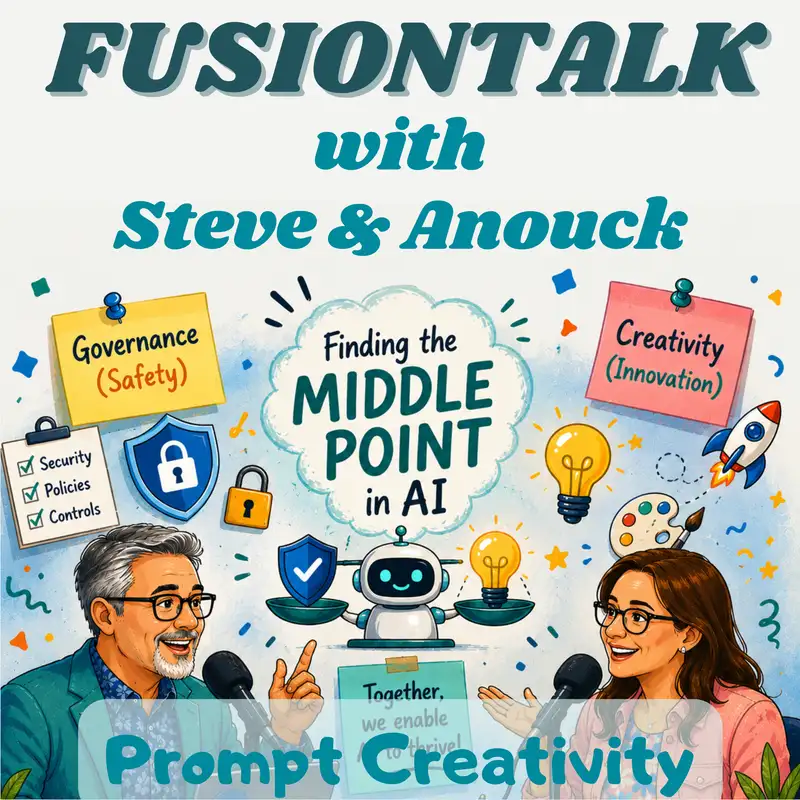
Anouk: Yes, it should be. So we are on the fourth episode around AI just picking up some key subjects. And today it's a little bit not governance and not creativity. It's actually one versus the other.
Steve: Yes. Um, it's more about talking about trying not to kill innovation with AI.
Anouk: Yes. Um, so that's the theme then. So how do you govern AI without killing innovation?
Steve: That's a very good question. And I still don't know the right answer to it.
Anouk: So, um, I'm gonna try and remember her name, but I know that I'm not going to. I had a, uh. It'll come back to me because I can see it. It'll come back to me. I, uh. The last south coast summit I went to, which was probably about two years ago, um, one of, uh, our MVP friends did a presentation, um, tell you it is. It's the lady that brings her husband along ever so often.
Steve: Nikki Chapel or Sara.
Anouk: Nikki Chapel's perfect. Yeah, so it's Nikki Chapel. And she did. And it was when kind of AI was doing a thing and Copilot was coming out and she did a presentation on the dangers of not getting your security. Right. And. And, uh, I completely disagreed with her. And I think that she's potentially changed her view a little bit now too, in that, um, like a lot of other people, she was basically saying, um, we don't secure our, uh, content. So now you need to secure your content because otherwise the wrong things will appear in your AI. Okay. Yeah. And I kind of said to her, I said, yeah, but that's. That's okay. But what is AI going to use to be creative? Yeah. So you need to kind of work out what that balance is, uh, and about where you need to be. And you need to have different dimensions. Uh, and it's the same as anything else. It's that I can be ultra secure at one end and then nobody gets any work done and I can be completely unsecure at the other end, um, with no governance whatsoever. Uh, and then everybody gets access to everything. And potentially you've got leaks of data, um, one's lots and lots of creativity and one's no creativity.
Steve: Yeah, true. I think you need to find your way in the middle between it.
Anouk: That's fairly good. I set that up for you. Because when I show two ends, obviously we need to be between them somewhere.
Steve: I think you need to find that way in the middle. And it's something like, uh, supporting creativity in a company. It's not only you support it, and it's not only based on AI or other, but all on the other things that you do in your company as well.
Anouk: But what if it's about layers? So what I've just said to you is legitimate. That's how we secure our, uh, content. We choose how much security we need and Away we go. But once you then start breaking that down, it could still be that some information that you have secured because owners do it and everything else, a different kind of dimension, needs to have access to that data. So for example, on every team site there's a library there for financial documents and in there are all the purchase orders and the invoices and everything else that my team or a team uses to manage their finances. Um, but finance need to be able to see that. So you also need to have a way, and I'm going to hit on sensitivity labels and data and stuff in a minute, but you need a way to be able to do that as well. So it's not just about locking down my site, it's about putting content in that the right people can see. And that is actually how you sort the governance versus creativity. Your governance needs to be multi dimensional.
Steve: Isn't that something we try to do in the most organisation already for years?
Anouk: Well, Kenyon, I, uh, think what we try to do is the single line. How secure do you want it to be? Oh, I can't be asked. So it becomes unsecure. Which is what Nicky was saying, of course, is that, you know, there's so much crap in your SharePoint sites, your copilot is basically making decisions or stuff on old content. So she was right in that you needed to be able to secure it or you need to have, you know, but it's not, it's multi dimensional to that. And I think, I think we're all at that stage now. Um, and so I think by using various levels, like sensitivity labels, for example, so that a content, um, can only be viewed by financial people, people in a financial group, then you can still have it open for the team, or you have it open to lots of people but use a different method of allowing what they and cannot use. The other thing is, um, within teams, uh, of course, and within your content types, um, you can now actually decide whether content does or does not get included in the AI. So that's another layer in the organisation that you have to kind of do. So, um, the quick responses and no answers because it's a short podcast. Governance versus creativity. If you want the, that ability to be creative and use your AI to give you new ideas, then you have to have a multi dimensional model to decide who does and who does not have access to content.
Steve: Yeah. And is a model like that already existing? I don't think so. Something you need to create in your organisation?
Anouk: Uh, well, your organisation probably already has that. If you look at Your active directory groups and access to some of your content. And you just need to translate that in some way to um, to your SharePoint and if you do it correctly, which everybody will of course. Um, and you use active directory groups that are auto populated based upon uh, department you're in, based upon your level of access, uh, to certain content. Then by using those same ad groups in your SharePoint environment, you're always covered and audiences and sensitivity labels.
Steve: Yeah, that's something I'm setting up with one of my customers at the moment in time.
Anouk: Uh, yes, it's not always so easy.
Steve: Yes, that's something I notice a lot these days that people are asking me, all right, you can help us with creating how the way we need to work in SharePoint and Teams, but be sure that AI is ready for it, that it's being ready for AI.
Anouk: Yes.
Steve: And it's those kind of things that we need to think about and that's what we try to do with the governance and the creativity for it.
Anouk: No, I agree entirely. So yeah, need to sort of think about data leakage and that kind of stuff and you use sensitivity labels to do that. And that governance model, you've got to work out how many layers are. I did a presentation at Bletchley once, um, and it was around security, uh, and I think we counted 14. I might be wrong on the number. So somewhere between 10 plus or minus 20, 30%. Um, what layers of governance, of security that you need to be able to put into play.
Steve: It's crazy.
Anouk: Yes and no. I think you. So we've got that line. Yeah, we're going to be ultra secure at one end or you can be not secure at the other end, but depending on where you are in the middle, you just build the model that suits your organisation. The problem is that what AI is doing is diversifying people that access and the information they access to or should have access to. So that's where the complication is, I think. But it is a matrix.
Steve: Yes. And you need to build that matrix and make sure that you have it and that you document it somehow.
Anouk: Correct. Um, I remember doing IsFab and uh, I said to Martin, so do you know what permission you want? Yeah, no, he does. Okay, so what do you want? He said, no, I can't tell you. I'm gonna have to build the spreadsheet first. And I ended up with this colossal spreadsheet of who could have access to what part of the organisation. And it took me eight hours of work just to set up both halves of the equation, but he knew what he wanted, I didn't have to manage it, so I wasn't too worried. But that's the other side, of course.
Steve: Then another thing in this discussion that we have about governance versus creativity, what with prompts, do you have the difference in public and private prompts? And are you opening it up for everyone?
Anouk: That's a great question, isn't it? So do you have most of the documents you create inside an organisation? Are they your documents or the organisation's documents?
Steve: I think most of the time it's going to be the organisational documents.
Anouk: Then prompts will be the same because it's being applied to the company data. So you need to find a way of being able to share those prompts from around the organisation.
Steve: Yes. And then we came back to the prompt library. We did two episodes before this one.
Anouk: Yes. And we are doing that presentation in Bletchley. Bletchley Innovation. You know, I don't do timelines in September, so if you look for collab days, Bletchley. Um, then 23rd of September, the 23rd of September. So Wednesday. Uh, but yes, that's to be an interesting prompt and that's a great place to go visit as well.
Steve: It is, but in that prompt library, we never said something about private or public or private. Is it something like when you start creating a document in your OneDrive that you did that you started off, you don't want to share it yet. Is that then your private prompt? Do we need to put it in that prompt library?
Anouk: Oh, it's a really good question, isn't it? And I've got four answers so far. Maybe no. Yes, and possibly. Um, I think if you get your governance and security matrix right, then it doesn't matter because a prompt will be private anyway and it will only give you access to the information that you're allowed to do. Or if even if you put that prompt in a public place for other people to run, it will be run in the same context. So it's a bit like work iq. Work iq, uh, is basically only going to give you content for what you're allowed to access. So getting that governance and that baseline right, I think is perfect. And then private, I mean, is a prompt like a password? You never tell anybody.
Steve: That's what people tend to do or do not want to talk a lot about it, because it's saving them work and they are experimenting and thinking that they are doing things wrong.
Anouk: I had. I had a very drunken afternoon in the pub yesterday with a friend that I haven't seen for a long time. Uh, we worked together and Sunday, uh, afternoons with his mates were all sitting there talking because AI came up in conversation. And Bob's been using AI for a long, long time. All right. Um, and, uh, he works in the construction trade. Um, but he said that what he's finding in most organisations is that people use AI but then they pretend it's their own work.
Steve: Yeah.
Anouk: Um, and because they feel that they want to protect their jobs. Um, and Bob works in a lot of government organisations. So people that, uh, you know, I'm not saying they're low down because there's some great public servant people and I love every one of you, but where a job is jobs worth and that kind of stuff then. And it's difficult to get promoted. And he found that very frustrating. So the idea of a private prompt, you need to know why you're trying to make it private. Is it because it's designed to pull information around that I wouldn't want them to do, that security might not do? Is it a prompt divine specifically for a process that I'm in? Is it a prompt designed that I just. The only one that, um. When people want information, I know how to get it and I can give it to them. It depends on the purpose. I don't think there ever should be a private prompt.
Steve: No, neither do I. I think we need to make it public and learn from each other. Because the way you write prompt. Way I write prompt, we can learn about and get better in it.
Anouk: Correct. Now, I agree entirely. But part of me is also said if you think of it as a process, then it's a little bit like setting up your rules in your outlook. They tend to be a bit personal to you about what you're trying to achieve. Uh, and same with worker iq. So you set a workflow in teams, you're defining it for what is important for you to do. I've got a great workflow in teams that goes through all of my transcripts for the week, tells me if I've got any tasks or things in there. Because I like just to know what tasks I'm ignoring and not doing because there's no priority in there.
Steve: That's the problem because you don't do
Anouk: task list and I don't do task lists. But it was good experiment set up, so that's cool.
Steve: Yeah.
Anouk: All right. Anything else we want to add to the list here? I think we've covered security labels and sensitivity labels, prompts, um, just to inform people.
Steve: We created these kind of IDs, and we started off with IDs, and we talked with, uh, ChatGPT about it, and ChatGPT just announced a fun angle about this one. And I, um, really, really love it.
Anouk: I'm going to say goodbye, so we're going to leave you with this wonderful AI quote.
Steve: Thank you. So the AI quote of ChatGPT is the fastest way to kill AI enthusiasm. A, uh, 14 page governance document. Think about that.

Listen to FusionTalk using one of many popular podcasting apps or directories.